

How to Choose a RAG Development Company for Your Business

Ankit Patel

August 13, 2026

15 min read
Table of contents
- Start With Your RAG Project Requirements
- What Separates a RAG Specialist?
- Technical Capabilities Your RAG Partner Should Have
- How Much Does RAG Development Cost?
- RAG Development Company vs Freelance RAG Developer
- RAG Development Company Selection Checklist
- Frequently Asked Questions
- Conclusion
Many businesses are adding AI to their products, internal tools, and customer support systems. But connecting an AI model to business information is not as simple as adding a chatbot to a website. The system needs to find the right information, understand the context, and use trusted company data when generating an answer. This is where Retrieval-Augmented Generation (RAG) can be useful.
A well-built RAG solution can work with company documents, databases, websites, knowledge bases, and other information sources. It can help employees find information faster, give customers more relevant answers, and make business data easier to access through natural language.
The challenge comes when a business needs to choose the right RAG development company. Many providers offer AI development, but not every team has hands-on experience with document processing, embeddings, vector search, retrieval pipelines, LLM integration, security, and RAG evaluation.
The challenge comes when a business needs to choose the right RAG development company. Many providers offer AI development, but not every team has hands-on experience with document processing, embeddings, vector search, retrieval pipelines, LLM integration, security, and RAG evaluation.
The right partner should understand both the technology and the business problem you are trying to solve. This guide explains what to check before hiring a RAG development company which technical skills matter, what questions to ask, common warning signs, and how to compare different providers before making a decision.
Start With Your RAG Project Requirements
Before contacting a RAG development company, take some time to define what you want the system to do. You don't need a complete technical specification at this stage. A clear understanding of the business goal, users, and data is enough to start a useful conversation with potential development partners.
A provider can recommend the right architecture and technology later. But if the business objective is unclear, it becomes difficult to judge whether a proposed solution is actually suitable.
Define the Business Problem
Start with one simple question:
What problem should the RAG application solve?
The answer could be very different from one business to another.
For example, a company may want an internal AI assistant that helps employees find information across hundreds of company documents. A customer-facing business may need an AI support assistant that answers questions using product manuals, policies, and help articles.
Other common use cases include:
- Internal knowledge assistants
- Enterprise AI search
- Customer support assistants
- Product information assistants
- Document-based question answering
- Research tools
- Legal document search
- Compliance knowledge systems
- Employee onboarding assistants
- Technical support applications
Defining the use case helps your development partner understand what kind of retrieval system, data pipeline, user interface, and security controls may be required.
For example, an internal employee assistant may need strict role-based access, while a public product support assistant may focus more on response speed and handling large numbers of users.
Identify the Data Your RAG System Will Use
The quality of a RAG application depends heavily on the information it can access. Before hiring a developer, make a basic list of the sources you want to connect.
Your data might be stored in:
- PDF files
- Word documents
- Excel files
- Websites
- Database records
- Cloud storage
- CRM platforms
- ERP systems
- Knowledge bases
- Customer support platforms
- Business APIs
You should also consider whether this information changes regularly.
For example, product documentation may be updated every few weeks, while company policies might change several times a year. A good RAG solution should have a sensible way to update its knowledge without rebuilding the entire system every time new information becomes available.
Ask potential providers how they plan to handle data ingestion, updates, document processing, and indexing. Their answer can tell you a lot about their practical RAG experience.
Decide Who Will Use the Application
The intended users also influence how the RAG solution should be designed.
Will it be used by:
- Employees?
- Customers?
- Sales Team?
- Support agents?
- Researchers?
- Managers?
- Technical teams?
- Multiple customer organizations?
This matters because different users may need access to different information.
For example, an employee in the finance department should not automatically receive access to confidential HR documents simply because both sets of information are stored in the same knowledge base.
A RAG development partner should therefore ask about user roles, permissions, authentication, and data access rules early in the project.
Set Clear Expectations for the First Version
You don't necessarily need to build the complete system from day one.
For a new RAG project, it can be useful to define a first version with a focused set of features. This might include one or two data sources, a simple chat interface, user authentication, source references, and basic response evaluation.
Once the first version has been tested with real users and real business questions, you can decide which areas need improvement.
This approach also gives you a better way to evaluate a RAG development company. Instead of judging a provider only by a sales presentation, you can assess how well its proposed solution handles your actual data and use cases.
Prepare a Simple Project Brief
Before speaking with potential providers, prepare a short document covering:
Business goal: What should the RAG application achieve?
Users: Who will use it?
Data sources: Where does the required information currently live?
Data volume: Roughly how much information needs to be processed?
Integrations: Which existing systems should connect with the application?
Security: Are there confidential or restricted documents?
Expected usage: How many users or queries do you expect?
Future plans: Will you add more data sources, users, or features later?
You don't need to know the technical answers yourself. The purpose of this brief is to give the development company enough context to suggest a suitable approach.
A provider that asks detailed questions about these areas before discussing technology or pricing is generally taking the project seriously.
Choosing a RAG development company should start with your business requirements, not a list of popular AI tools. Once you know what problem you want to solve, which data needs to be connected, who will use the system, and how the application may grow, it becomes much easier to compare development partners on their actual capabilities.
What Separates a RAG Specialist From a General AI Provider?
Not every company that builds AI applications has the same level of experience with Retrieval-Augmented Generation. A team may have strong skills in mobile apps, chatbots, machine learning, or general software development but still lack the knowledge needed to build a reliable RAG system.
This difference matters because RAG involves several connected steps. Your documents need to be prepared correctly, useful information needs to be indexed, relevant content needs to be retrieved, and the language model needs to generate an answer based on that information.
A best RAG development company should understand the complete process rather than focusing only on the language model.
Look at the Full RAG Pipeline
A typical RAG workflow can be viewed as:
Business data → Data processing → Chunking → Embeddings → Indexing → Retrieval → Reranking → LLM → Response → Evaluation
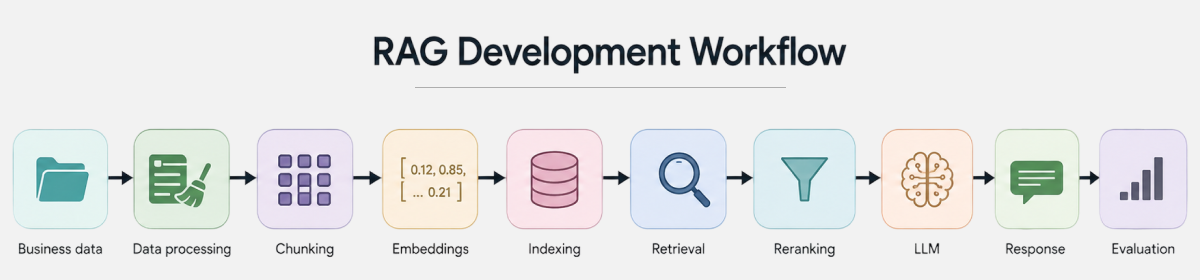
Each stage can affect the final answer.
For example, if a 200-page document is split into poorly selected sections, the retrieval system may fail to find the information needed to answer a simple question. Even a highly capable language model cannot fully correct a problem that starts with poor source data.
When speaking with a potential development partner, ask how they approach each stage of the pipeline. You don't need to understand every technical detail. What matters is whether the team can explain its decisions in clear terms and connect those decisions to your business requirements.
Don't Judge a Provider by a Demo Alone
A polished chatbot demo can look impressive, but it doesn't tell you how the system will perform with your own data.
A demo might use
- A small collection of clean documents
- Carefully prepared questions
- A limited number of users
- A simple retrieval setup
- No complex permission rules
A production application can be very different.
Your business may have thousands of documents, duplicate information, outdated files, different file formats, restricted content, and users asking questions in many different ways.
Before selecting a provider, ask for details about how the proposed system will be tested with real business data and realistic user questions.
A good development team should be comfortable discussing both successful and unsuccessful retrieval cases. Knowing where a system can fail is just as important as showing where it works.
Check How They Handle Data Quality
Data preparation is one of the areas that can have a major effect on RAG performance.
Business information is rarely perfectly organized. Documents may contain:
- Repeated content
- Tables
- Headers and footers
- Scanned pages
- Outdated versions
- Different naming conventions
- Images containing important information
- Inconsistent formatting
A capable RAG team should have a clear process for preparing this information before it reaches the retrieval system.
Ask how they plan to identify outdated documents, handle duplicate content, preserve useful metadata, and deal with different document formats.
This is often more important than simply asking which AI model they plan to use.
Ask How Retrieval Works
Retrieval is at the heart of a RAG application.
When a user asks a question, the system needs to find the information that is most relevant to that question. If the wrong content is retrieved, the final response may also be wrong or incomplete.
A development partner should be able to explain whether the project will use approaches such as:
- Semantic search
- Keyword search
- Hybrid search
- Metadata filtering
- Reranking
The right approach depends on the type of information you have and the questions users are likely to ask.
For example, semantic search can be useful when users ask questions using different wording from the source documents. Keyword search can be valuable when users need exact product codes, names, or technical terms. In some applications, combining both approaches can provide better results.
Ask About RAG Evaluation
A reliable RAG system needs more than a successful deployment. Its answers should be tested regularly.
Ask the provider:
How will you know whether the RAG application is giving useful answers?
The answer should include some form of evaluation.
Depending on the project, this may include measuring:
- Retrieval relevance
- Answer accuracy
- Context relevance
- Groundedness
- Citation quality
- Response time
- Failure rates
The team should also create test questions based on real business scenarios.
For example, if you're building an internal HR assistant, testing should include questions about leave policies, benefits, employee procedures, and restricted information—not just generic questions designed to produce impressive demo responses.
Understand How They Handle Incorrect or Missing Information
A responsible RAG application should not pretend to know something that isn't available in its approved sources.
Ask your potential partner:
What happens when the system cannot find enough information to answer a question?
The application may need to:
- Tell the user that the information is unavailable
- Request clarification
- Show relevant source documents
- Route the question to a human
- Provide a limited response based only on available information
This is particularly important for business applications where an incorrect answer can lead to financial, operational, or compliance problems.
A provider that discusses these situations openly is more useful than one that simply promises highly accurate AI responses.
Check Their Experience With Real Business Integrations
RAG applications often need to work with systems that are already part of your business.
For example, a company may want its AI assistant to use information from a CRM, internal database, cloud storage platform, or customer support system.
That means the development team needs more than LLM experience. It should understand APIs, authentication, data synchronization, permissions, and system architecture.
Ask potential providers about similar integrations they have handled and how they approach secure access to business information.
Look for Practical Problem-Solving
Technical knowledge is important, but practical thinking matters just as much.
Suppose your business has five years of documents, but only the latest versions should be used for answers. A good provider should think about document versioning and metadata instead of simply loading everything into a vector database.
Or suppose different departments have different access permissions. The team should consider those rules when designing the retrieval process rather than trying to add them after deployment.
These examples show why RAG development experience should be evaluated through the way a company approaches problems—not only through the technologies listed on its website.
A Simple Way to Evaluate a RAG Provider
Before moving forward, ask each company to explain five things:
- 1. How will you prepare our data?
- 2. How will relevant information be retrieved?
- 3. How will you measure response quality?
- 4. How will you protect restricted information?
- 5. How will the system handle growth and future data sources?
Compare the answers rather than comparing technology names alone.
A provider that understands your data, asks the right questions, explains trade-offs, and has a clear testing plan is usually a stronger candidate than one that simply promises a chatbot powered by the latest LLM.
The right RAG partner should understand data, retrieval, language models, security, integrations, and evaluation as one connected system. Don't choose a provider solely because it works with a popular LLM or has an attractive demo.
The real test is whether the team can explain how it will turn your business information into reliable, useful answers—and how it will measure and improve the system after launch.
Technical Capabilities Your RAG Development Partner Should Have
Once you have shortlisted a few potential providers, the next step is to look at their technical capabilities. You don't need to hire a company simply because it mentions every new AI tool. What matters is whether its team can choose the right technology for your data, users, security requirements, and expected workload.
A strong RAG development company should be comfortable working across the retrieval pipeline and should also be able to explain why a particular technology is appropriate for your project.
LLM Selection Should Match the Use Case
Large language models (LLMs) generate the final response in a RAG system, but the newest or largest model is not automatically the best choice.
Depending on your requirements, a LLM development and consulting company may work with models from providers such as OpenAI, Google, Anthropic, Meta, or other open-source ecosystems.
The right choice can depend on:
- Response quality
- Context window
- Cost per request
- Response speed
- Data privacy requirements
- Hosting options
- Language support
- Expected number of users
For example, a customer support assistant handling thousands of daily questions may have different requirements from an internal research tool used by a small team.
Ask potential providers why they recommend a particular model rather than simply asking which models they support. A good answer should connect the model choice to your actual requirements.
Embedding Expertise Matters
Embeddings convert text into numerical representations that allow a system to compare the meaning of different pieces of information.
This is an important part of semantic retrieval.
For example, a user might ask:
| "What is the process for taking annual leave?"
The source document might use the phrase:
| "Employee vacation request procedure."
The wording is different, but the meaning is closely related. Embeddings help the retrieval system recognize that relationship.
Your development partner should understand how to select and use embedding models based on factors such as:
- Language
- Document type
- Search requirements
- Data volume
- Retrieval accuracy
- Infrastructure cost
They should also have a process for testing whether the selected embeddings work well with your actual business data.
Vector Database Knowledge
A RAG system commonly stores embeddings in a vector database or another system capable of efficient similarity search.
Popular technologies include:
- Pinecone
- Weaviate
- Qdrant
- Milvus
- Chroma
- pgvector
The important point is not which name appears on a provider's website. The provider should understand the differences between these options and recommend one based on your project.
Consider factors such as:
- Data volume
- Search speed
- Infrastructure
- Filtering requirements
- Hosting preferences
- Security & Scalability
For some businesses, a managed vector database may be convenient. Others may prefer a self-hosted or database-integrated approach because of security, infrastructure, or cost considerations.
Semantic Search and Hybrid Search
A RAG application may need more than one way to find relevant information.
Semantic search looks at the meaning behind a query. This is useful when users don't use the exact wording found in your documents.
Keyword search can be useful when users search for exact terms, product IDs, model numbers, names, or specific phrases.
Hybrid search combines different retrieval methods to improve the chances of finding relevant information.
For example, imagine a technical support application where a user asks about a specific product model. Semantic search can understand the broader meaning of the question, while keyword matching can make sure the exact model number is not overlooked.
Your RAG development partner should be able to determine which retrieval method fits your data instead of automatically using one approach for every project.
Reranking Can Improve Retrieved Results
Retrieval may return several potentially relevant pieces of information. But they are not always equally useful.
A reranking stage can review the initial results and reorder them based on their relevance to the user's question.
This can be useful when your knowledge base contains a large amount of similar information.
For example, if your company has hundreds of product documents, the first search may return several documents related to the same product category. Reranking can help place the most relevant content higher in the final context provided to the LLM.
Ask your provider whether reranking is necessary for your use case and how they plan to test its impact on answer quality.
Data Ingestion Should Be Designed for Your Sources
Your business information may come from many places, and each source can have different requirements.
A RAG development company should be able to work with sources such as:
- PDFs
- Websites
- Word documents
- Spreadsheets
- Databases
- Cloud storage
- APIs
- Knowledge management systems
The process generally involves collecting the information, cleaning it, splitting it into useful sections, adding relevant metadata, creating embeddings, and making it available to the retrieval system.
The approach should also account for future updates.
If your product documentation changes every week, for example, manually rebuilding the entire knowledge base would quickly become inconvenient. A better system may use automated or scheduled data synchronization.
Chunking Strategy Should Not Be Overlooked
Chunking is the process of dividing larger documents into smaller sections that can be retrieved when needed.
There isn't one chunk size that works for every application.
If chunks are too small, important context may be lost. If they are too large, the retrieval system may return more information than the LLM needs.
The right approach depends on:
- Document structure
- Content type
- Question patterns
- Context requirements
- Retrieval method
A good provider should test its chunking strategy against real examples instead of choosing a value simply because it worked for another project.
Metadata Can Make Retrieval More Useful
Metadata adds information about each piece of content.
Depending on your application, this could include:
- Document title
- Department
- Date
- Product category
- Author
- Version
- Region
- Access level
Metadata filtering can then help the system narrow down the information it retrieves.
For example, an employee asking about a company policy may need the latest version applicable to their region. Metadata can help the retrieval system avoid older or unrelated documents.
This becomes particularly important for large enterprise knowledge bases.
Framework Experience Is Useful, But It Isn't Everything
You may see frameworks such as LangChain and LlamaIndex mentioned by RAG providers. These tools can simplify parts of application development and help connect data sources, retrieval systems, and language models.
However, don't select a provider solely because it uses a particular framework.
Frameworks change over time. Your business needs may also change.
The more important question is whether the RAG development team understands the concepts behind the framework and can adapt the architecture when your project requires something different.
Ask About Cloud and Deployment Options
Where your RAG application runs can affect security, cost, performance, and maintenance.
Depending on your requirements, possible options include:
- Public cloud
- Private cloud
- On-premise infrastructure
- Hybrid environments
A business handling sensitive internal information may have different deployment requirements from a startup building a public product support assistant.
Your development partner should discuss these options before RAG development starts and explain the trade-offs involved.
The Technology Stack Should Follow the Requirement
One of the easiest mistakes is to start with technology instead of the problem.
For example:
Poor approach: "We want to use a particular vector database because it is popular."
Better approach: "We need fast semantic search across several million records, strict access controls, metadata filtering, and room for future growth. Which architecture fits those requirements?"
This difference matters.
A capable RAG development team should recommend technologies based on your expected data volume, user behavior, security needs, integrations, budget, and future plans.
Look for best RAG development company that understands LLMs, embeddings, vector databases, retrieval methods, reranking, data ingestion, chunking, metadata, deployment, and evaluation—and, more importantly, knows how to combine them for your specific use case.
How Much Does RAG Development Cost?
There is no single price for building a RAG application. The final cost depends on the project's scope, data volume, integrations, security requirements, AI models, and expected number of users.
Key cost factors include:
- Number and type of data sources
- Document processing requirements
- LLM selection
- Embedding and vector database setup
- Third-party integrations
- User authentication
- Custom interface
- Security requirements
- Testing and evaluation
- Cloud infrastructure
- Post-launch maintenance
A small RAG MVP with limited data sources will generally require less development effort than an enterprise platform supporting multiple databases, thousands of users, advanced permissions, and continuous data synchronization.
For this reason, it's better to request a project-based estimate after defining the technical and business requirements rather than relying on a generic RAG development cost.
RAG Development Company vs Freelance RAG Developer
The right option depends on the complexity of your project.
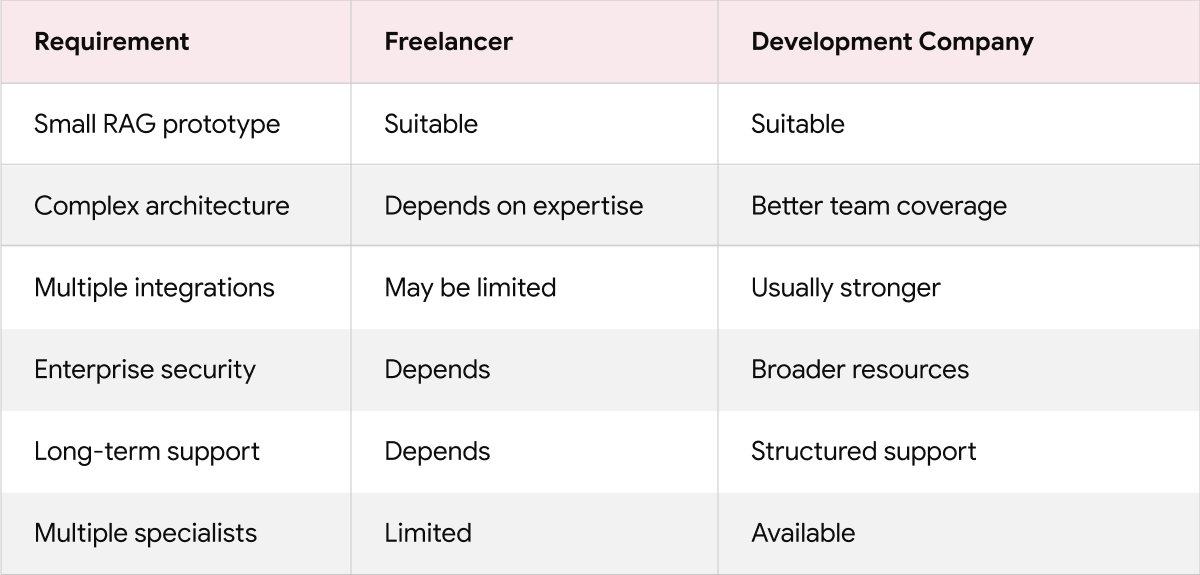
For a small proof of concept, an experienced RAG developer may be enough. Larger projects involving multiple systems, security requirements, custom interfaces, and long-term maintenance may benefit from a dedicated development team.
RAG Development Company Selection Checklist
Don't select a provider based only on the lowest quote or the number of AI technologies listed on its website. Look at how well the team understands your data, business requirements, users, and long-term goals. Before making your final decision, check whether the provider offers:
- RAG architecture expertise
- LLM and embedding knowledge
- Vector database experience
- Data processing capabilities
- Security practices
- Integration experience
- RAG evaluation methods
- Scalable architecture
- Clear communication
- Post-launch support
Frequently Asked Questions
Finding a RAG development company often comes with questions about technical expertise, project cost, development timelines, data security, and ongoing support. The answers below cover some of the common questions businesses ask before starting a RAG project. They can help you compare potential development partners and understand what to consider before moving forward with a RAG solution.
How do I choose a RAG development company?
Look for practical RAG experience, LLM expertise, vector database knowledge, strong data handling, security practices, integration capabilities, scalability, and post-launch support.
What should I look for in a RAG developer?
A RAG developer should understand data processing, embeddings, vector search, retrieval, LLM integration, APIs, evaluation, and basic security principles.
How long does it take to build a RAG application?
A basic RAG application can take several weeks to a few months, while larger enterprise solutions can require significantly more time depending on integrations, data volume, and testing.
Can RAG work with private business data?
Yes. RAG can be designed to work with private business information, provided the architecture includes appropriate security, access controls, and data-handling practices.
Conclusion
Choosing a RAG development company is ultimately about finding a team that understands more than language models. Your partner should be able to work with your business data, design an appropriate retrieval approach, protect sensitive information, connect existing systems, and measure the quality of the final responses.
Before making a decision, compare providers based on technical experience, data security, retrieval quality, scalability, integration capabilities, communication, pricing, and long-term support.
The right partner can help turn RAG from a simple AI experiment into a useful business application that works with your organization's own knowledge and continues to support changing requirements.

You May also Like

AI Development Services
AI Taxi App Development: Features, Cost & Development Guide
- Ankit Patel
- |
- August 4, 2026

AI Development Services
AI Development Services: Types, Use Cases, Benefits, and Pricing
- Ankit Patel
- |
- July 16, 2026