

AI Taxi App Development: Features, Cost & Complete Development Guide

Ankit Patel

August 4, 2026

10 min read

Table of contents
- What is AI Taxi App Development?
- How AI Taxi App Development Is Transforming the Ride-Hailing Industry
- Must-Have Features of an AI Taxi App
- AI Technologies Used in Taxi App Development
- Benefits of AI Taxi App Development
- AI Taxi App Development Cost
- How to Choose the Right AI Taxi App Development Company
- Frequently Asked Questions About Build AI Taxi App
- Conclusion
Artificial Intelligence (AI) is reshaping industries worldwide, and the transportation sector is no exception. From intelligent route planning and predictive demand forecasting to automated ride matching and real-time fleet management, AI has become a driving force behind modern taxi booking platforms. Businesses entering the ride-hailing market are no longer focused on building a basic taxi booking application—they are investing in AI taxi app development to deliver smarter, faster, and more personalized experiences for passengers and drivers alike.
Unlike traditional taxi booking platforms that rely on predefined rules, AI-powered taxi applications continuously analyze user behavior, traffic conditions, ride demand, driver availability, and historical trip data to make intelligent decisions in real time. This enables businesses to improve operational efficiency while offering a superior user experience.
Whether you're a startup launching a ride-hailing platform or an established transportation company upgrading your existing application, investing in AI can provide a significant competitive advantage. Modern AI technologies such as machine learning, predictive analytics, natural language processing (NLP), computer vision, and generative AI help create intelligent transportation solutions capable of adapting to changing customer expectations.
In this comprehensive guide, you'll learn what AI taxi app development involves, how artificial intelligence is transforming the ride-hailing industry, the essential features every AI-powered taxi application should include, the technologies used during development, estimated development costs, and the key factors to consider when choosing an AI development partner.
What is AI Taxi App Development?
AI taxi app development is the process of building ride-hailing applications that use artificial intelligence to automate operations, improve decision-making, and deliver personalized experiences for passengers, drivers, and fleet operators. Instead of relying solely on manual inputs and fixed business rules, AI-powered taxi apps continuously learn from data and optimize their performance over time.
Traditional taxi booking applications typically offer features such as ride booking, GPS tracking, fare calculation, payment processing, and trip history. While these features remain essential, AI significantly enhances their capabilities by making every interaction smarter and more efficient.
For example, an AI-powered taxi app can automatically predict ride demand during peak hours, recommend optimal pickup locations, estimate arrival times more accurately, detect fraudulent activities, suggest efficient driving routes, and adjust pricing based on traffic patterns and customer demand. These intelligent capabilities improve both operational performance and customer satisfaction.
AI also enables businesses to automate repetitive tasks that previously required manual intervention. Customer support can be handled through AI-powered chatbots, driver performance can be monitored using predictive analytics, and fleet managers can receive automated insights for improving overall business efficiency.
The result is an intelligent taxi booking platform that continuously improves as it collects more operational data. Businesses benefit from higher productivity, better resource utilization, reduced operational costs, and improved customer retention.
How AI Taxi App Development Is Transforming the Ride-Hailing Industry
The ride-hailing industry has become increasingly competitive. Customers expect faster bookings, transparent pricing, shorter waiting times, safer rides, and highly personalized services. Meeting these expectations using conventional software alone has become difficult, which is why businesses are rapidly adopting AI development solutions for transportation platforms.
One of the biggest advantages of AI is its ability to automate complex operational decisions. Instead of manually assigning rides, intelligent dispatch systems automatically match passengers with the most suitable drivers based on location, availability, traffic conditions, driver ratings, and estimated arrival times. This reduces idle time while improving overall fleet efficiency.
AI also improves route optimization by analyzing live traffic conditions, road closures, weather updates, and historical travel data. Drivers receive smarter navigation recommendations that reduce travel time, lower fuel consumption, and improve on-time arrivals. For fleet operators, these efficiencies translate into lower operating costs and higher profitability.
Another major reason businesses invest in AI is predictive analytics. Machine learning models can forecast demand in different locations and at different times of the day. This allows companies to position drivers strategically before demand increases, reducing passenger waiting times and maximizing driver earnings.
Customer experience has also become a key differentiator in the ride-hailing industry. AI-powered recommendation engines personalize promotions, preferred ride options, loyalty rewards, and payment preferences based on user behavior. Intelligent chatbots provide instant assistance around the clock, while automated fraud detection systems improve payment security and reduce financial risks.
As artificial intelligence continues to evolve, businesses that adopt AI early will be better positioned to improve operational efficiency, deliver exceptional customer experiences, and build scalable transportation platforms that can adapt to future market demands.
Must-Have Features of an AI Taxi App
Building a successful taxi booking platform requires more than standard booking and payment features. Today's users expect intelligent recommendations, faster ride matching, accurate fare estimates, and seamless communication throughout their journey. This is where AI taxi app development creates a significant advantage.
A modern AI-powered taxi application generally consists of three integrated platforms: the Passenger App, the Driver App, and the Admin Panel. Each module uses artificial intelligence to automate tasks, improve decision-making, and deliver a better experience for everyone involved.
Customer App Features
The passenger application is the customer-facing component of an AI taxi platform. It should provide a smooth, secure, and personalized booking experience while reducing waiting times and improving ride accuracy.
1. Easy Registration and Secure Login
A simple registration process is the first step toward a positive user experience. Passengers should be able to create accounts using their email address, mobile number, or social media profiles.
AI can further enhance security by identifying suspicious login attempts, detecting unusual account activity, and minimizing fraudulent registrations without affecting genuine users.
2. Smart Ride Booking
Booking a ride should require only a few taps.
Instead of manually selecting every detail, AI analyzes previous bookings, favorite destinations, travel habits, and frequently used pickup points to provide personalized ride suggestions. This reduces booking time while making the application feel more intuitive for regular users.
3. Intelligent Fare Estimation
One of the biggest concerns for passengers is knowing the ride cost before confirming a booking.
AI-powered pricing systems calculate estimated fares using multiple real-time factors, including:
• Distance
• Current traffic conditions
• Ride demand
• Weather
• Peak-hour activity
• Vehicle availability
This provides passengers with transparent pricing while helping businesses optimize revenue through dynamic pricing models.
4. Real-Time Driver Matching
Traditional taxi applications assign nearby drivers based mainly on location.
AI improves this process by considering multiple variables, such as:
• Driver ratings
• Current traffic
• Estimated arrival time
• Driver availability
• Trip completion history
• Passenger preferences
As a result, passengers receive faster pickups and higher-quality service.
5. Live GPS Tracking
Real-time tracking has become an essential feature for ride-hailing applications.
AI enhances GPS navigation by continuously monitoring traffic congestion, accidents, road closures, and route changes. The system automatically recommends the fastest available route, improving arrival accuracy and reducing delays.
This also increases passenger confidence by allowing them to track the driver's location throughout the trip.
6. AI-Powered Customer Support
Passengers expect immediate assistance whenever they encounter an issue.
Instead of waiting for a human support representative, AI-powered chatbots can instantly answer frequently asked questions related to bookings, cancellations, payments, refunds, or driver information.
Natural Language Processing (NLP) enables these virtual assistants to understand conversational language and provide accurate responses around the clock.
7. Real-Time Driver Matching
A successful taxi application should support various payment methods, including:
• Credit and debit cards
• UPI
• Digital wallets
• Internet banking
• Cash
• Corporate accounts
Artificial intelligence can also detect suspicious payment activity, helping reduce fraud while protecting customer transactions
Driver App Features
Drivers are equally important to the success of an AI-powered taxi platform. A well-designed driver application improves productivity, increases earnings, and minimizes unnecessary travel time.
1. Smart Ride Requests
Rather than assigning rides randomly, AI evaluates multiple data points before recommending trips.
These include:
• Driver location
• Vehicle availability
• Customer ratings
• Driver acceptance rate
• Traffic conditions
• Estimated trip profitability
This intelligent ride allocation helps maximize driver utilization while improving customer satisfaction.
2. AI Route Optimization
Traffic conditions change every minute.
Machine learning algorithms continuously analyze live traffic, accidents, weather updates, and road closures to recommend the fastest and most fuel-efficient route. Benefits include:
• Reduced travel time
• Lower fuel costs
• Increased trip completion
• Better customer experience
3. Earning Dashboard
Drivers should have complete visibility into their daily and monthly performance.
An AI-powered dashboard can provide insights such as:
• Daily earnings
• Peak earning hours
• Ride acceptance rate
• Customer ratings
• Incentive tracking
• Suggested working hours
These analytics help drivers maximize their income by making informed decisions.
4. Intelligent Navigation Assistance
Beyond traditional GPS navigation, AI continuously updates routes based on changing road conditions.
Instead of waiting for traffic jams to occur, predictive analytics forecasts congestion and recommends alternative routes before delays happen.
5. Voice Assistant Integration
Voice-enabled assistance improves safety by reducing the need for drivers to interact with the mobile application while driving. Drivers can:
• Accept rides
• Contact passengers
• Navigate destinations
• Check trip details
using simple voice commands.
6. Performance Monitoring
Artificial intelligence continuously evaluates driver performance using various metrics such as punctuality, ride completion, customer ratings, cancellation rates, and driving behavior.
Fleet managers can use these insights to reward high-performing drivers while identifying opportunities for training and improvement.
Admin Panel/Backend Features
The admin dashboard serves as the operational control center of an AI taxi platform. It provides complete visibility into business performance while automating everyday management tasks.
1. AI Fleet Management
Fleet managers can monitor every vehicle in real time through a centralized dashboard.
Artificial intelligence provides valuable insights into:
• Vehicle utilization
• Driver availability
• Active trips
• Idle vehicles
• Maintenance schedules
These insights improve resource allocation while reducing operational costs.
2. Intelligent Ride Dispatch
One of the most valuable AI capabilities is automated dispatch management.
Instead of assigning drivers manually, AI instantly matches passengers with the most appropriate driver using factors such as location, estimated arrival time, traffic conditions, driver ratings, and historical trip performance.
This significantly improves booking efficiency and reduces passenger waiting time.
3. Predictive Demand Analytics
Machine learning models analyze historical ride patterns, weather forecasts, holidays, local events, and traffic data to predict future demand.
Fleet managers can proactively position drivers in high-demand areas before ride requests increase. This leads to:
• Higher booking success
• Better driver utilization
• Increased revenue
• Reduced idle time
• Dynamic Pricing Management
AI continuously monitors market demand and automatically adjusts pricing during peak hours, special events, or high-demand locations.
Unlike traditional surge pricing, intelligent pricing models consider multiple business factors to maintain fairness while maximizing profitability.
4. Business Intelligence Dashboard
An AI-powered analytics dashboard provides decision-makers with real-time insights into platform performance. Key metrics include:
• Total bookings
• Revenue trends
• Ride completion rate
• Customer retention
• Driver productivity
• Peak operating hours
• Popular travel routes
These insights help businesses make data-driven decisions and identify opportunities for growth.
5. Fraud Detection and Security
Fraud prevention has become increasingly important in ride-hailing applications.
AI systems continuously monitor platform activity to identify unusual behavior such as:
• Fake bookings
• Multiple account creation
• Payment fraud
• GPS manipulation
• Suspicious ride patterns
By detecting anomalies in real time, businesses can protect both passengers and drivers while maintaining platform integrity.
AI Technologies Used in Taxi App Development
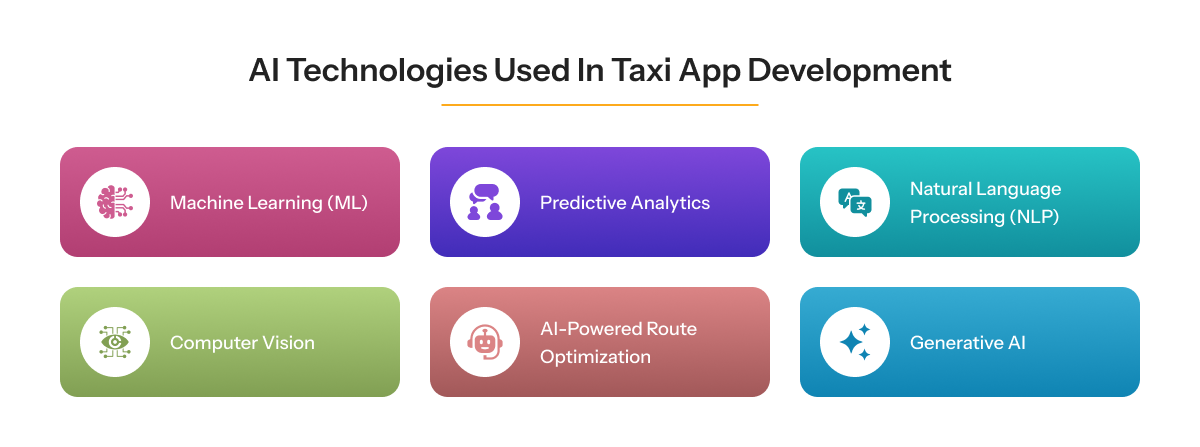 Artificial intelligence has become the foundation of next-generation transportation platforms. Instead of relying on static algorithms, modern taxi applications use AI technologies to analyze real-time data, automate operations, and continuously improve user experiences. Selecting the right technology stack ensures that an AI-powered taxi app remains scalable, secure, and capable of adapting to changing business needs.
Below are the key AI technologies commonly used during AI taxi app development.
Machine Learning (ML)
Machine learning enables taxi applications to learn from historical trip data and improve decision-making over time without manual programming.
ML models analyze thousands of ride requests, customer preferences, traffic patterns, and driver behavior to deliver smarter recommendations.
Common use cases include:
• Intelligent ride matching
• Demand prediction
• Driver performance analysis
• Customer behavior analysis
• Dynamic pricing optimization
• Personalized ride recommendations
As more data becomes available, machine learning continuously improves prediction accuracy, helping businesses increase operational efficiency and customer satisfaction.
Predictive Analytics
Predictive analytics helps transportation businesses anticipate future demand instead of reacting to it.
By analyzing historical bookings, seasonal trends, weather conditions, local events, and peak-hour traffic, AI predicts where ride requests are likely to increase.
This enables businesses to:
• Position drivers in high-demand areas
• Reduce passenger waiting time
• Improve ride availability
• Increase fleet utilization
• Maximize driver earnings
Predictive analytics also supports better business planning by identifying long-term growth opportunities.
Natural Language Processing (NLP)
Natural Language Processing allows AI systems to understand, interpret, and respond to human language naturally.
Within a taxi booking application, NLP powers intelligent chatbots and virtual assistants that provide instant customer support.
Passengers can quickly receive assistance for:
• Booking inquiries
• Ride cancellations
• Payment issues
• Refund requests
• Driver information
• Account-related questions
This reduces customer support costs while providing faster responses around the clock.
Computer Vision
Computer vision enables AI systems to interpret images and video in real time.
Although still emerging in ride-hailing platforms, it offers valuable capabilities such as:
• Driver identity verification
• Vehicle document validation
• License plate recognition
• Safety monitoring
• Damage detection during inspections
These features help improve platform security while reducing manual verification efforts.
AI-Powered Route Optimization
Navigation plays a critical role in every taxi booking platform.
AI continuously analyzes:
• Live traffic conditions
• Road closures
• Construction updates
• Weather forecasts
• Accident reports
Based on this information, intelligent routing algorithms recommend the fastest and most efficient travel path. Benefits include reduced travel time, lower fuel consumption, improved punctuality, and enhanced customer satisfaction.
Generative AI
Generative AI is becoming increasingly valuable for modern mobility applications.
It can automate customer interactions, summarize support conversations, generate operational reports, assist drivers with common questions, and create personalized recommendations for passengers.
Businesses also use generative AI to improve internal workflows, simplify documentation, and automate repetitive administrative tasks.
As AI models continue evolving, generative AI will play an even greater role in enhancing customer engagement and operational efficiency.
Benefits of AI Taxi App Development
Artificial intelligence provides measurable advantages for transportation companies, drivers, and passengers alike. By automating critical operations and delivering data-driven insights, AI helps businesses operate more efficiently while creating a better user experience.
Benefits for Businesses
Improved Operational Efficiency
AI automates ride dispatch, route planning, pricing, and customer support, allowing businesses to manage large fleets with fewer manual processes.
Improved Operational Efficiency
AI automates ride dispatch, route planning, pricing, and customer support, allowing businesses to manage large fleets with fewer manual processes.
Better Decision-Making
Real-time analytics help business owners monitor platform performance, identify customer trends, optimize fleet allocation, and improve overall profitability.
Higher Revenue Opportunities
Dynamic pricing, intelligent driver allocation, and demand forecasting help maximize booking opportunities while reducing idle vehicle time.
Reduced Operating Costs
Automation minimizes repetitive administrative tasks, lowers customer support expenses, reduces unnecessary fuel consumption, and improves fleet utilization.
Scalable Business Growth
AI-powered platforms can handle growing numbers of users, vehicles, and ride requests without major infrastructure changes, making expansion into new markets much easier.
Benefits for Cusstomers
Passengers expect convenience, speed, and transparency whenever they book a ride.
AI improves the overall customer experience by providing:
• Accurate fare estimates
• Shorter waiting times
• Personalized ride suggestions
• Live vehicle tracking
• Safer payment processing
• 24/7 AI-powered customer support
• Better ride recommendations
The result is a smoother booking experience that increases customer satisfaction and loyalty.
Benefits for Drivers
Drivers also gain significant advantages from AI-powered taxi applications.
These include:
• Faster ride assignments
• Optimized driving routes
• Reduced idle time
• Improved daily earnings
• Intelligent navigation assistance
• Performance insights
• Automated incentive tracking
AI enables drivers to complete more trips while spending less time searching for passengers.
AI Taxi App Development Cost
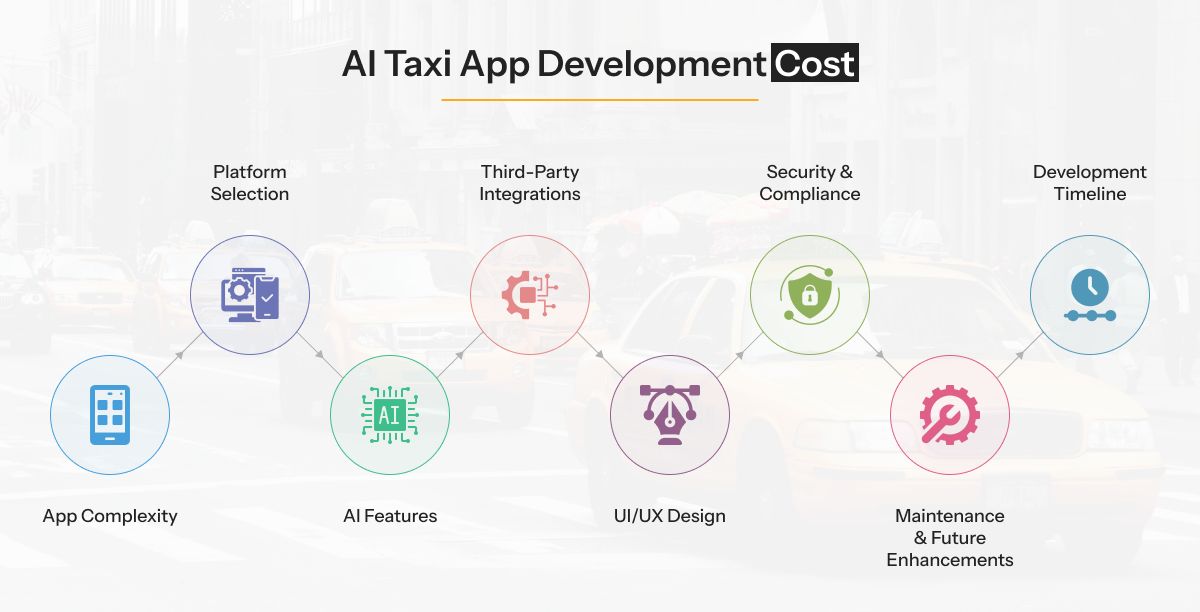
One of the most common questions businesses ask is: "How much does AI taxi app development cost?
The answer depends on several technical and business factors. Every project has different requirements, making it difficult to define a single fixed price.
Some organizations need a basic taxi booking platform with essential AI capabilities, while others require enterprise-level applications supporting multiple cities, thousands of drivers, advanced analytics, intelligent automation, and cloud-based infrastructure.
Below are the primary factors influencing development costs.
1. App Complexity
The complexity of your application significantly impacts the overall budget.
A basic MVP generally includes:
• User registration
• Ride booking
• GPS tracking
• Payment integration
• Driver management
Advanced applications may additionally include:
• AI-powered dispatch
• Dynamic pricing
• Predictive demand forecasting
• Fleet analytics
• AI chatbots
• Voice assistants
• Driver behavior analysis
• Business intelligence dashboards
The more intelligent features included, the greater the development effort.
2. Platform Selection
Businesses can choose to develop applications for:
• Android
• iOS
• Cross-Platform
• Web Dashboard
• Web Application
Supporting multiple platforms simultaneously typically requires additional development resources but helps reach a broader audience.
3. AI Features
The level of artificial intelligence integrated into the application also affects development timelines. Examples include:
• Machine learning models
• Recommendation engines
• Predictive analytics
• Computer vision
• Generative AI
• Intelligent pricing algorithms
• Natural language processing
More advanced AI capabilities require additional data preparation, model training, testing, and optimization.
4. Third-Party Integrations
Taxi applications often integrate external services such as:
• Google/Apple maps
• Payment gateways
• SMS gateways
• Cloud hosting
• Analytics platform
• CMS integration
• Custome ticket support
The number and complexity of integrations directly influence the overall project scope.
5. UI/UX Design
A well-designed interface improves customer retention and driver productivity.
Custom animations, interactive dashboards, accessibility improvements, and personalized user experiences require additional design and development effort.
6. Security and Compliance
Transportation platforms process sensitive customer information and financial transactions.
Implementing secure authentication, encrypted communication, payment security, fraud detection, and regulatory compliance increases both development quality and project cost while ensuring long-term reliability.
7. Maintenance and Future Enhancements
Launching the application is only the beginning. Ongoing maintenance typically includes:
• AI model optimization
• Feature enhancements
• Security updates
• Performance improvements
• Cloud monitoring
• Bug fixes
• Compatibility updates
Planning for continuous improvement ensures the platform remains competitive as customer expectations and technology evolve.
8. Development Timeline
The time required to build an AI-powered taxi application depends on project complexity, feature requirements, integrations, and testing. In general:
• Basic MVP: 3–4 months
• Mid-Level AI Taxi App: 5–7 months
• Enterprise-Grade AI Platform: 8–12 months
How to Choose the Right AI Taxi App Development Company
Choosing the right technology partner is one of the most important decisions when building an AI-powered taxi platform. The success of your application depends not only on innovative features but also on the expertise of the development team, their understanding of the transportation industry, and their ability to deliver scalable AI development solutions.
Some organizations need a basic taxi booking platform with essential AI capabilities, while others require enterprise-level applications supporting multiple cities, thousands of drivers, advanced analytics, intelligent automation, and cloud-based infrastructure.
1. Evaluate AI Expertise
Artificial intelligence is a specialized field that goes beyond traditional software development. Choose a company with proven experience in machine learning, generative AI, predictive analytics, natural language processing (NLP), and intelligent automation.
Review their portfolio to understand the type of AI-powered applications they have developed and whether they have experience building transportation or mobility solutions.
2. Look for Industry Experience
Every industry has unique operational challenges. A company with experience in ride-hailing, logistics, fleet management, or transportation will better understand driver workflows, passenger expectations, route optimization, and dispatch management.
Industry knowledge often results in faster development, fewer revisions, and more practical business solutions.
3. Review Technical Capabilities
A reliable development partner should be familiar with modern AI technologies and cloud platforms.
Look for expertise in technologies such as:
• Machine Learning
• Generative AI
• TensorFlow
• PyTorch
• Large Language Models (LLMs)
• Computer Vision
• Natural Language Processing
• Cloud Computing
• API Integrations
• Data Analytics
A modern technology stack helps ensure your application remains scalable and adaptable as AI continues to evolve.
4. Prioritize Security
Taxi applications manage personal information, payment details, and real-time location data. Strong security measures are essential to protect users and maintain business credibility.
Choose a company that follows secure development practices, implements encrypted communication, supports secure authentication, and complies with applicable data protection regulations.
5. Consider Scalability
Your application should support future business growth without requiring a complete rebuild.
Whether you plan to expand into multiple cities, onboard thousands of drivers, or introduce additional mobility services, your AI platform should be designed to scale efficiently.
A scalable architecture reduces future development costs while improving long-term performance.
6. Evaluate Communication and Project Management
Successful AI projects require continuous collaboration between business stakeholders and development teams.
Choose a company that provides:
• Clear project milestones
• Regular progress updates
• Transparent communication
• Dedicated project managers
• Agile development methodology
Strong communication minimizes misunderstandings and keeps projects on schedule.
7. Ask About Post-Launch Support
Launching the application is only the first milestone.
AI models require continuous optimization as customer behavior, traffic conditions, and market trends change. Reliable development partners should provide:
• Performance monitoring
• AI model retraining
• Security updates
• Bug fixes
• Feature enhancements
• Technical support
Continuous maintenance ensures your taxi application remains competitive and performs efficiently over time.
Frequently Asked Questions About AI Taxi App
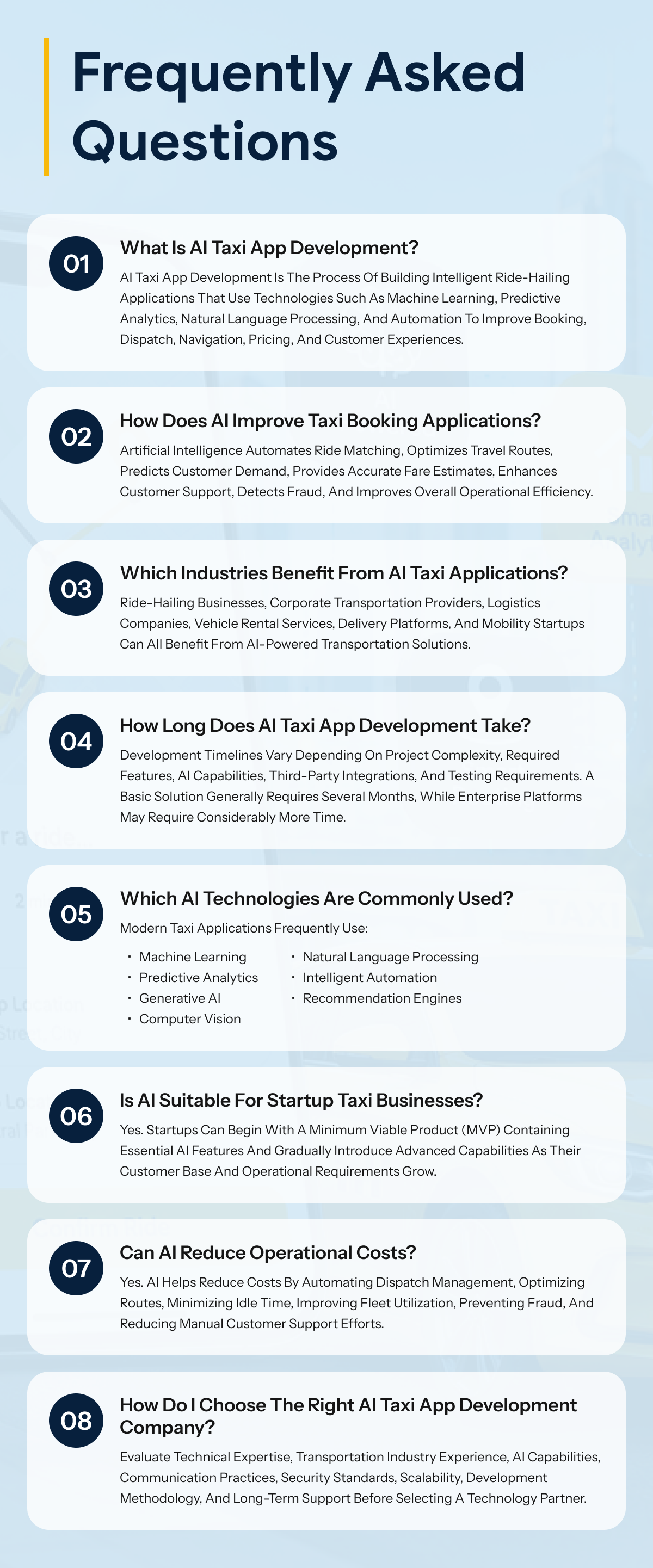
Choosing the right approach to AI taxi app development often raises important questions about technology, costs, timelines, features, and selecting the right AI development company. The answers below address some of the most common questions businesses ask before investing in an AI-powered taxi booking solution. These insights will help you make informed decisions and better understand what to expect throughout the development process.
Final Verdict
Artificial intelligence is redefining how transportation businesses operate by making taxi services smarter, faster, and more efficient. From intelligent ride matching and predictive demand forecasting to automated customer support and optimized fleet management, AI taxi app development enables businesses to deliver exceptional experiences while improving operational performance.
As customer expectations continue to evolve, investing in AI-powered mobility solutions can help transportation companies remain competitive, improve resource utilization, and create sustainable long-term growth. Whether you are building a new ride-hailing platform or upgrading an existing application, selecting the right technologies and partnering with an experienced development team will play a critical role in the success of your project.
A well-planned AI taxi application is more than a digital booking platform—it is a scalable business solution designed to adapt to changing market demands, support future innovation, and deliver lasting value for passengers, drivers, and businesses alike.


Ankit Patel is the Project Delivery Head at XongoLab Technologies LLP and PeppyOcean, leading mobile app development companies specializing in custom software & mobile app solutions. Passionate about technology and innovation, he enjoys writing about mobile & software development, business, and marketing. His articles have been featured on renowned publications, including YourStory, E27, Datafloq, JaxEnter, TechTarget, Adobe, DesignWebKit, InstantShift, Business Magazine, Simple Programmer, and many others.
View All Post
You May also Like

AI Development Company
Top 10 AI Development Companies in 2026: Find the Best AI Partner
- Ankit Patel
- |
- July 27, 2026

AI Development Services
AI Development Services: Types, Use Cases, Benefits, and Pricing
- Ankit Patel
- |
- July 16, 2026

AI & Intelligent Automation
Top AI Development Services Businesses Are Investing
- Ankit Patel
- |
- July 1, 2026