

How AI Chatbots Help Businesses Grow
AI chatbots help businesses improve customer support, generate qualified leads, automate routine tasks, and create better customer experiences. Learn how businesses use AI chatbots to increase efficiency, support sales, and streamline operations, along with how an AI chatbot development company can build solutions tailored to their goals.

Ankit Patel

October 23, 2026

10 min read

Table of contents
- Why Are AI Chatbots Becoming Important for Businesses?
- 7 Ways AI Chatbots Help Businesses Grow
- A Real-World Example: How Klarna Used an AI Assistant
- How an AI Chatbot Development Company Helps Businesses
- What AI Chatbot Development Services Should Include
- How to Measure Whether Your Chatbot Is Delivering Value
- Choosing the Right Development Partner
- Frequently Asked Questions About AI Chatbots for Business Growth
- Final Thoughts
AI chatbots are changing how businesses communicate with customers, handle enquiries, and manage everyday operations. From answering product questions to helping customers complete purchases, these tools can take care of routine interactions while employees focus on work that requires human judgement. For growing companies, the real value lies in connecting chatbot capabilities to specific business goals—not simply adding a chat window to a website.
A well-planned chatbot can help a business respond faster, capture potential leads outside office hours, support customers across multiple channels, and reduce repetitive work. However, results depend on the quality of the solution, the information it can access, and how well it fits existing business processes.
In this article, we explain where AI chatbots create value, what real businesses have achieved, and how the right AI development partner can help turn the technology into a practical business tool.
Why Are AI Chatbots Becoming Important for Businesses?
Customers often expect quick answers before they decide whether to purchase a product, book a service, or contact a company. When a business takes too long to respond, a potential customer may simply choose another provider.
Traditional support teams cannot always respond instantly, particularly when enquiries arrive after working hours or during busy periods. AI chatbots help fill that gap by handling common questions, collecting relevant details, and directing customers to the appropriate next step.
The shift is already visible in India. According to research published by ServiceNow in March 2025, 80% of surveyed Indian consumers used AI chatbots for activities such as checking complaint status, getting product recommendations, and accessing self-help guides. The same research found that 82% said new AI tools had raised their expectations of customer service. Source: ServiceNow.
For businesses, this creates a clear reason to improve digital customer interactions. A chatbot that provides useful answers and connects people to the right service can make the buying journey easier. A poorly designed one, however, can create frustration rather than solve it.
7 Ways AI Chatbots Help Businesses Grow
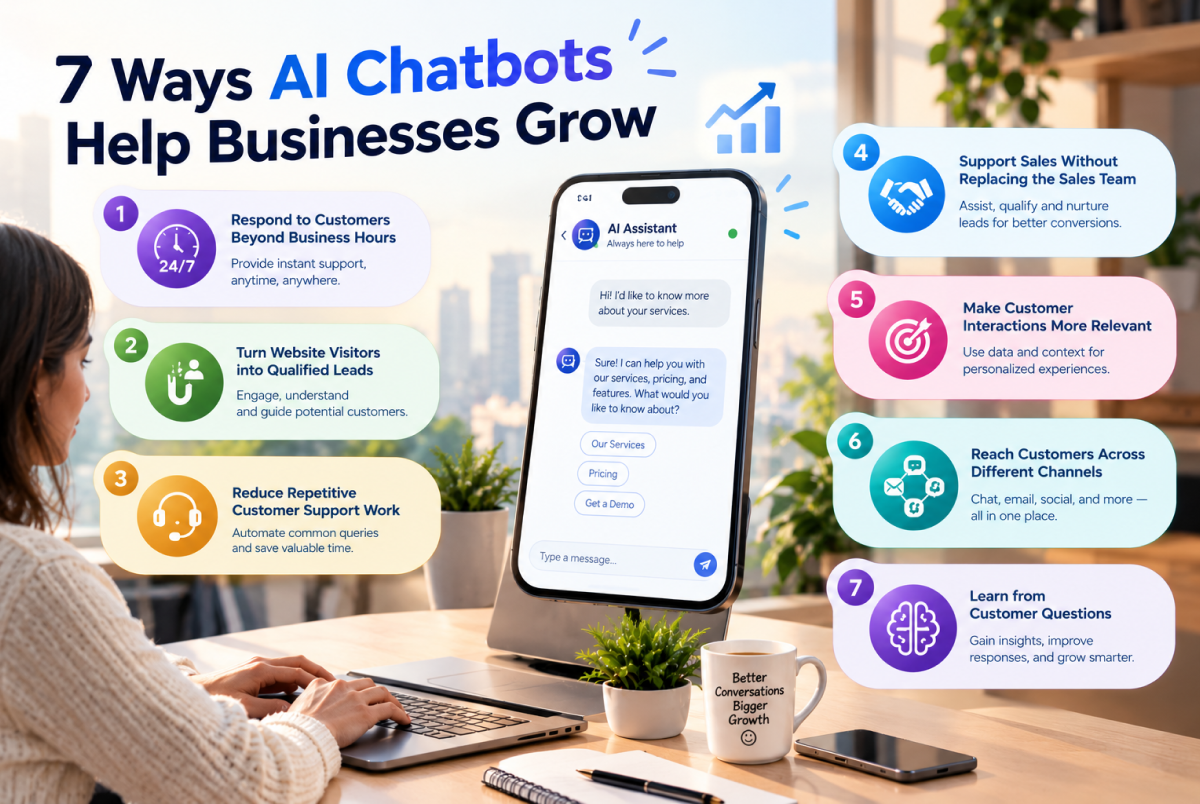
1. Respond to Customers Beyond Business Hours
A customer might visit an online store late at night, enquire about a software product during a holiday, or check appointment availability before work. Without an available support channel, these interactions may have to wait until the next business day.
AI chatbots can answer routine questions around the clock, provided the necessary information is available and the system is operating correctly.
For example, a software development company could use a chatbot to explain its service categories, ask visitors about their project requirements, and collect contact details for a follow-up discussion.
The benefit is not that every enquiry automatically becomes a sale. It is that interested visitors have a way to move forward without waiting for someone to become available.
2. Turn Website Visitors into Qualified Leads
Getting visitors to a website is only one part of customer acquisition. Businesses also need to understand what those visitors want and help them take the next step.
A sales-focused chatbot can ask relevant questions about a prospect's budget, requirements, preferred timeline, or industry. Based on the answers, it can direct the visitor towards a suitable service, booking form, product page, or sales representative.
Consider a company offering custom mobile app development. Its chatbot could ask whether a visitor needs an Android application, an iOS application, or both. It could then collect information about the proposed features and project deadline before passing the enquiry to the sales team.
This gives the team a more useful starting point than a contact form containing only a name and email address.
Businesses should still measure lead quality, sales-qualified enquiries, and conversion rates. A chatbot that generates many conversations but few relevant leads may need better questions or clearer qualification rules.
3. Reduce Repetitive Customer Support Work
Support teams regularly answer the same questions about delivery status, refunds, account access, service availability, billing, and product features.
An AI chatbot can handle suitable routine enquiries using approved company information. When connected to the relevant systems, it may also retrieve order details, create a support ticket, or guide a customer through a standard process.
Salesforce's 2025 State of Service research reported that AI resolved 30% of service cases in the organizations surveyed, with that figure expected to reach 50% by 2027. The forecast is not a guarantee for every business, but it illustrates the direction in which customer service operations are moving. Source: Salesforce.
The practical advantage is that employees can spend less time answering repeated questions and more time resolving complex complaints, helping important customers, and improving service quality.
4. Support Sales Without Replacing the Sales Team
Customers often need more information before making a purchase. They may want to compare products, understand pricing, check compatibility, or learn which service suits their requirements.
A chatbot can guide customers through these decisions by presenting relevant information based on their questions. In an online store, for example, it could help a shopper compare product specifications or locate a suitable item. In a B2B business, it could explain service options and direct qualified prospects to a consultation.
For more advanced use cases, a chatbot can connect with a product catalogue or CRM system to provide more relevant answers.The objective is to remove unnecessary friction from the buying process. For high-value purchases, complex negotiations, and sensitive decisions, human sales professionals remain important.
5. Make Customer Interactions More Relevant
A generic response does not always answer a customer's actual question. Personalisation becomes more useful when a chatbot can access relevant information and understand the context of the conversation.
For example, a travel company could use a chatbot to answer questions about booking policies, destination information, and available services. If properly integrated with its reservation system, it might also help a customer check booking details or identify available options.
Personalisation must be based on information the business is permitted to use. Customers should not be shown sensitive information without appropriate verification, and chatbot access should follow the same privacy and security standards as other business systems.
When implemented carefully, relevant responses can make interactions more convenient without making customers repeat the same information several times.
6. Reach Customers Across Different Channels
Customers do not all communicate in the same way. Some prefer a website chat window, while others use a mobile application or messaging platform.
Businesses can make support more accessible by deploying chatbots through the channels their customers already use. Depending on the project, these may include websites, mobile apps, WhatsApp, or internal workplace tools.
A consistent experience matters more than simply being present on every platform. If a chatbot provides one answer on a website and a conflicting answer on another channel, customers may lose confidence in the business.
Connecting the chatbot to a shared knowledge source and carefully managing channel-specific workflows can help maintain consistency as the company grows.
7. Learn from Customer Questions
Every conversation can provide useful information about customer needs, provided the business collects and analyses it appropriately.
Chatbot analytics can reveal frequently asked questions, common reasons for abandoned purchases, recurring complaints, and information customers struggle to find. These patterns may point to problems with website navigation, product descriptions, pricing information, or the service process itself.
Suppose an online retailer notices that many customers ask whether a product is compatible with a particular device. The company could improve its product pages, add a compatibility guide, and update the chatbot's approved information.
In this way, chatbot data can inform broader business improvements. Teams should review the findings regularly and avoid treating automated conversation data as a complete picture of customer sentiment.
A Real-World Example: How Klarna Used an AI Assistant
Klarna, the global payments and shopping company, provides a documented example of AI being used at a large scale in customer service.
Suppose an online retailer notices that many customers ask whether a product is compatible with a particular device. The company could improve its product pages, add a compatibility guide, and update the chatbot's approved information.

In February 2024, Klarna reported that its OpenAI-powered assistant had handled 2.3 million conversations during its first month, representing approximately two-thirds of its customer service chats. The company said average resolution time fell from 11 minutes to under two minutes, while repeat enquiries declined by 25%. These figures were reported by Klarna in its announcement and should be understood as company-reported results rather than a guarantee of what another business will achieve. Source: Klarna's announcement via PR Newswire.
What can other businesses learn from this example?
First, AI can handle a substantial volume of routine customer interactions when it is connected to suitable workflows. Second, the value should be measured through outcomes such as resolution time and repeat enquiries—not simply the number of conversations handled.
There is also an important lesson about implementation: automation should not remove access to human support. Customers with unusual requests, sensitive concerns, or unresolved problems need a clear way to reach a person.
Klarna's experience demonstrates what may be possible at scale, but each business needs to evaluate its own customer volume, service requirements, and operational constraints.
How an AI Chatbot Development Company Helps Businesses
Buying a chatbot tool is not the same as building a chatbot that works reliably within a business. A successful implementation requires decisions about customer journeys, data access, integrations, security, and the tasks the chatbot should be allowed to perform.
An experienced AI chatbot development company can help businesses plan these elements around specific commercial objectives.
• Understand the Business Requirements
The first step is to identify the problem worth solving. A business might want to qualify leads, answer support questions, help users navigate a mobile app, or give employees quicker access to internal information.
Defining the goal helps determine what the chatbot needs to do and how success will be measured.
• Select the Right Chatbot Approach
Not every use case needs a complex generative AI system. A rule-based chatbot may be suitable for a simple, predictable process, while a retrieval-based or generative AI chatbot may be more appropriate for questions that require contextual understanding.
The right approach depends on the complexity of the conversation, the reliability required, the available data, and the cost of operating the system.
• Connect the Chatbot to Existing Software
A chatbot becomes more useful when it can work with the systems employees already use. Depending on the business requirements, integrations may include a CRM, helpdesk, inventory platform, booking system, payment service, or internal knowledge base.
These connections need proper access controls, data validation, and safeguards. A chatbot should only retrieve information and carry out actions that its permissions allow.
• Test Accuracy, Security, and Escalation
Before launch, developers should test real customer questions, ambiguous requests, unexpected inputs, and situations in which the chatbot does not know the answer.
Testing should also cover privacy, access permissions, response quality, performance under load, and the handover to human staff.
After deployment, monitoring helps teams identify incorrect responses, failed workflows, and areas where the knowledge base needs updating.
What AI Chatbot Development Services Should Include
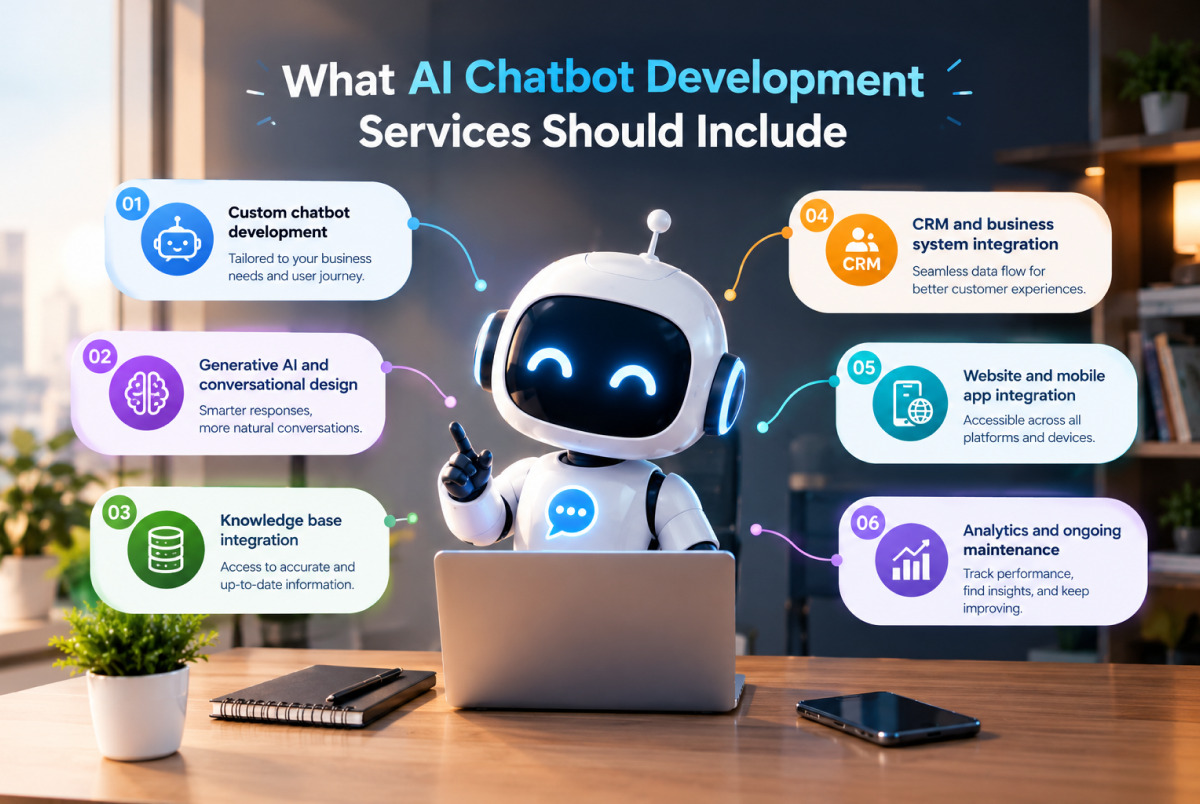
The scope of AI chatbot development services varies according to business needs, but a well-planned project may include:
• Custom chatbot development: A solution designed around the company's customers, products, and workflows.
• Generative AI and conversational design: Natural-language interactions that can interpret context and respond to a wider range of questions.
• Knowledge base integration: Access to approved company documents, product information, policies, and support material.
• CRM and business system integration: Connections that allow the chatbot to retrieve authorised information or initiate defined workflows.
• Website and mobile app integration: Chat interfaces embedded in the platforms customers already use.
• Analytics and ongoing maintenance: Performance tracking, conversation reviews, updates, and improvements based on actual usage.
Businesses should ask prospective providers how they will measure success, protect data, manage unexpected responses, and handle requests that require human intervention. These questions are often more revealing than a long list of technologies.
How to Measure Whether Your Chatbot Is Delivering Value
Launching a chatbot is only the beginning. Businesses need a clear way to determine whether it is improving the customer experience or making operations more efficient.
Useful performance indicators include:
• First-response time: How quickly customers receive an initial answer.
• Resolution rate: The percentage of eligible enquiries resolved without additional assistance.
• Lead qualification rate: How many chatbot-generated leads meet the sales team's requirements.
• Conversion rate: Whether chatbot-assisted visitors are more likely to complete a purchase, booking, or enquiry.
• Customer satisfaction: Whether users find the chatbot's responses helpful.
• Escalation rate: How often conversations need to be transferred to a human representative.
• Cost per resolved enquiry: The cost of handling a successfully resolved interaction.
Compare these metrics with a reliable baseline from before implementation. Segment results by enquiry type and customer journey, since a chatbot may perform well for FAQs but poorly for complicated complaints.
The goal is not to automate every conversation. It is to improve the outcomes that matter to the business and its customers.
How to Measure Whether Your Chatbot Is Delivering Value
Before selecting an AI chatbot development company, review its ability to understand your business processes, integrate with existing software, and support the chatbot after launch.
Ask for examples of relevant projects, a clear implementation plan, realistic timelines, and an explanation of how the provider will test and monitor the solution. Discuss data ownership, third-party model costs, privacy requirements, and the process for handling errors.
It is also worth starting with a focused use case rather than attempting to automate every customer interaction at once. A pilot covering a specific set of questions or workflows can help establish whether the solution delivers enough value to justify expansion.
For businesses planning a custom solution, XongoLab provides AI chatbot development services for conversational experiences and integrations tailored to business requirements. The right starting point is a clear understanding of the problem, the intended users, and the result the business wants to achieve.
Frequently Asked Questions About AI Chatbots for Business Growth
Businesses considering chatbot implementation often have practical questions about cost, functionality, and expected results. The answers below can help clarify what to evaluate before starting a project.
1. How do AI chatbots help businesses grow?
AI chatbots can support growth by responding to enquiries, qualifying leads, assisting customers during purchases, and automating repetitive support tasks. Their actual impact depends on the use case, implementation quality, and how performance is measured.
2. Are AI chatbots suitable for small businesses?
Yes. Small businesses can begin with a focused chatbot that answers common questions, collects enquiries, or helps customers book appointments. Starting with a limited scope can keep implementation and maintenance manageable.
3. Can an AI chatbot increase sales?
A chatbot can support sales by answering product questions, guiding visitors towards relevant options, and capturing qualified leads. Increased sales are not guaranteed; businesses should compare conversion rates and lead quality before and after implementation.
4. How long does it take to develop an AI chatbot?
The timeline depends on the chatbot's capabilities, integrations, data requirements, testing needs, and security requirements. A simple FAQ chatbot generally requires less work than a system connected to multiple business applications.
5. Is it better to build a custom chatbot or use an existing platform?
An existing platform may suit businesses with straightforward requirements and limited integration needs. Custom development may be more appropriate when the chatbot must follow specific workflows, connect with proprietary systems, or meet particular security and user experience requirements.
6. Can AI chatbots replace human customer support teams?
AI chatbots can handle many routine interactions, but they should not be expected to replace human support entirely. Complex complaints, sensitive situations, exceptions, and decisions requiring judgement should have a clear route to a qualified person.
7. How much do AI chatbot development services cost?
Costs depend on the chosen AI model, conversation complexity, integrations, security controls, usage volume, and ongoing maintenance. Businesses should evaluate the full operating cost, including third-party API usage and monitoring, rather than considering development fees alone.
Final Thoughts
AI chatbots can help businesses respond to customers faster, manage routine enquiries, support sales teams, and identify opportunities to improve their services. The strongest results come from choosing a clear business problem and building a solution that addresses it reliably.
Before investing, define the outcome you want, identify the systems and information the chatbot needs, and establish how you will measure success. Start with a manageable use case, test it with real scenarios, and improve it using customer feedback and performance data.
With the right planning and implementation partner, a chatbot can become a useful part of a company's customer experience and day-to-day operations—not just another feature on its website.


Ankit Patel is the Project Delivery Head at XongoLab Technologies LLP and PeppyOcean, leading mobile app development companies specializing in custom software & mobile app solutions. Passionate about technology and innovation, he enjoys writing about mobile & software development, business, and marketing. His articles have been featured on renowned publications, including YourStory, E27, Datafloq, JaxEnter, TechTarget, Adobe, DesignWebKit, InstantShift, Business Magazine, Simple Programmer, and many others.
View All Post
You May also Like
AI Development Company
Top 10 AI Development Companies in 2026: Find the Best AI Partner
- Ankit Patel
- |
- July 27, 2026

AI Development Services
AI Development Services: Types, Use Cases, Benefits, and Pricing
- Ankit Patel
- |
- July 16, 2026

AI & Intelligent Automation
Top AI Development Services Businesses Are Investing
- Ankit Patel
- |
- July 1, 2026