

AI Agent Development: Use Cases, Architecture and Business Benefits

Jignesh Nakrani

July 8, 2026

7 min read
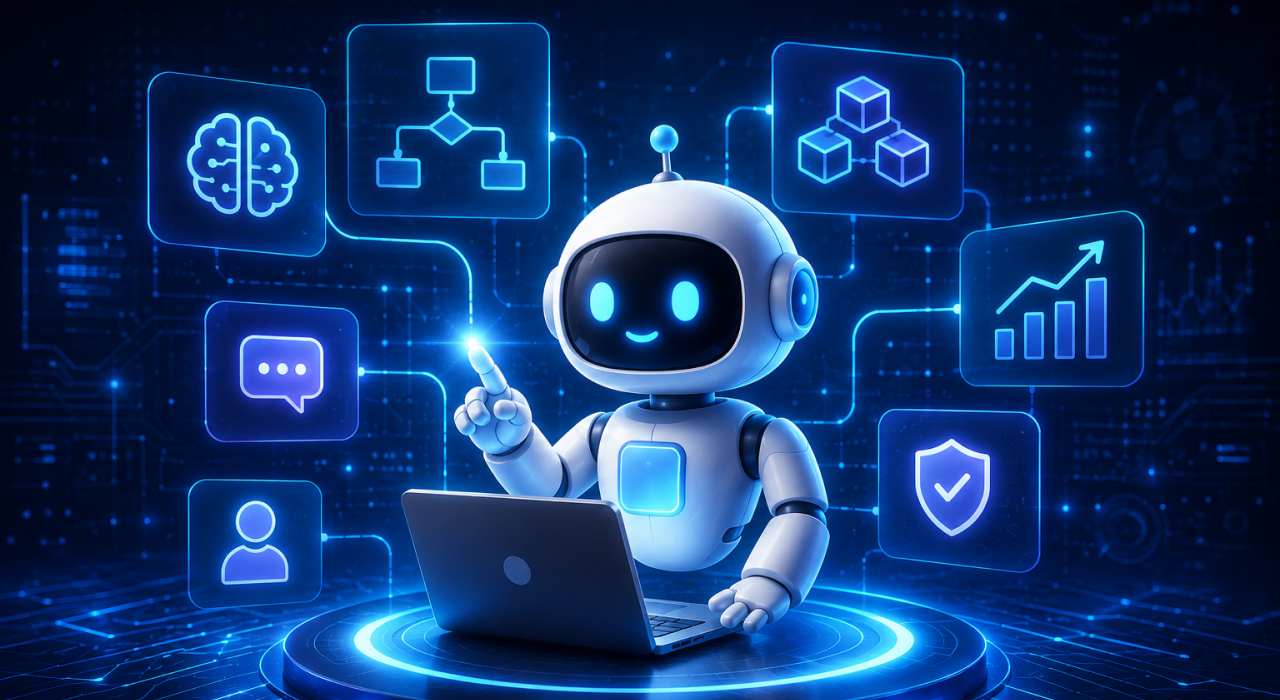
Table of contents
- What AI Agents Are - and Why the Hype Is Mostly Justified
- How AI Agents Actually Work: Core Architecture
- AI Agent Use Cases Delivering Real Business Value
- Business Benefits of AI Agent Development
- What Makes AI Agent Development Hard
- What to Expect From a Professional AI Agent Development Engagement
- FAQ
- Conclusion
What AI Agents Are - and Why the Hype Is Mostly Justified
Most AI features are reactive. You ask a question, you get an answer. You provide an input, you get an output. The interaction is one-shot: you drive, the AI responds.
AI agents are different. They're designed to pursue a goal across multiple steps, using tools, making decisions, and adjusting their approach based on what they encounter along the way - with minimal human intervention between steps.
The simplest way to understand the difference: a standard LLM integration is like asking a very capable assistant a question. An AI agent is like handing that assistant a task and a set of resources, and telling them to get it done.
That distinction - from single-shot response to goal-directed execution - is why AI agent development has become one of the fastest-growing categories in enterprise AI investment. Gartner predicted that by 2025, agentic AI would be embedded in at least 33% of enterprise software applications. Based on what's happening in production environments right now, that estimate may be conservative.
This isn't hype without substance. Agents are delivering measurable results in customer support, sales operations, finance, logistics, HR, and software development. But building agents that perform reliably in production - as opposed to impressive demo environments - requires a level of architectural rigor that separates serious AI development companies from the rest.
This article breaks down how AI agents work, where they're delivering value, and what it takes to build one properly.
How AI Agents Actually Work: Core Architecture
Understanding agent architecture isn't just useful for engineers. For business leaders evaluating AI agent development, it provides the vocabulary to ask the right questions, set realistic expectations, and understand where the genuine complexity lies.
The Perceive-Reason-Act Loop
At its core, every AI agent operates on a loop: perceive the current state of the environment, reason about what action to take, act on that reasoning, observe the result, and repeat.
In practice, the "environment" is whatever inputs the agent is connected to: incoming messages, database records, API responses, documents, form submissions, system alerts. The "reasoning" is handled by a large language model - typically GPT-4, Claude, Gemini, or an open-source model - which interprets the current state and decides what to do next. The "action" is executing one of the tools available to the agent: sending a message, querying a database, calling an API, writing to a file, triggering a workflow.
This loop continues until the agent reaches its goal, hits an error condition, or encounters a situation that requires human judgment. The sophistication of the agent lies in how that reasoning step is designed - how clearly the goal is defined, how the agent handles ambiguity, how it prioritizes actions, and how it fails gracefully when something unexpected happens.
Memory: How Agents Maintain Context
One of the things that makes agents more powerful than one-shot LLM calls is memory - the ability to maintain context across steps and across sessions.
Agents typically work with three types of memory. Short-term or working memory holds the current conversation, task state, and recent observations - this lives in the model's context window. Episodic memory stores records of past interactions and task outcomes that can be retrieved when relevant - often implemented using vector databases. Semantic memory holds persistent knowledge about the domain, the user, or the business - the facts and rules the agent draws on consistently.
Designing memory architecture well is one of the less glamorous but most consequential parts of agent development. An agent that can't remember what it did three steps ago, or that loses context when a session ends, is frustrating to use and unreliable in production.
Tools: What Agents Can Act On
An agent's capabilities are defined by its tools - the functions it can call to interact with the world. Common tool categories include web and database search, API calls to external services, code execution environments, document reading and writing, email and calendar integration, CRM and ERP system access, and notification or alert systems.
The tool design matters enormously. Tools need to be scoped carefully - an agent that has access to everything it could theoretically need is also an agent that can cause unexpected harm if its reasoning goes wrong. Good agent development involves deliberate decisions about what each agent can and cannot do, with appropriate guardrails around high-stakes actions.
Single-Agent vs. Multi-Agent Systems
For focused use cases - handling customer support for a specific product, or automating a specific document processing workflow - a single well-designed agent is usually the right architecture. It's simpler to build, easier to test, and more predictable in behavior.
More complex workflows often benefit from multi-agent systems, where specialized agents collaborate: an orchestrator agent that manages the overall task and delegates subtasks to specialist agents that handle specific functions. A sales prospecting system might use a research agent to gather company information, a qualification agent to assess fit, a writing agent to draft personalized outreach, and an orchestrator to coordinate the sequence and handle exceptions.
Multi-agent architectures are more powerful but substantially more complex to build and maintain. They should be chosen because the use case genuinely requires them, not because they sound impressive.
AI Agent Use Cases Delivering Real Business Value
The following use cases represent areas where AI agents are moving from pilot to production in 2026 - with measurable impact on cost, speed, or revenue.
Customer Support Agents
Customer support is the most widely deployed AI agent use case, and for good reason. It's high-volume, involves predictable workflows, has clearly measurable outcomes, and the cost of the status quo - large support teams handling repetitive tier-1 queries - is well understood.
Modern customer support agents go well beyond simple chatbot scripts. They can authenticate customers, look up account information, process standard requests (password resets, order status updates, subscription changes), escalate complex or emotional interactions to human agents with full context, and log every interaction for quality review.
A well-built customer support agent handles 40-70% of incoming queries end to end, without human involvement. The queries it can't resolve are escalated with context intact - reducing the friction and time cost of handoffs. Human agents spend more of their time on the work that actually requires judgment.
The measurable outcomes: reduced average handle time, lower cost per resolution, faster first-response times, and higher availability (agents handle queries outside business hours without staffing implications).
Sales and Business Development Agents
Sales agents represent one of the highest-ROI deployments of agentic AI, because the value of improving sales efficiency is directly tied to revenue. The workflows that sales agents handle well include prospect research and qualification, personalized outreach drafting, CRM data hygiene and entry, follow-up sequencing, and competitive intelligence gathering.
A sales development agent might work like this: given a target company, it researches the company's recent activity (funding rounds, hiring patterns, product launches, executive changes), identifies the right contacts based on role and seniority, drafts personalized outreach referencing relevant context, queues the message for human review, and updates the CRM record - all in the time it would take a human SDR to do a fraction of that work for one prospect.
Companies deploying well-designed sales agents are reporting 3-4x increases in outreach volume with no headcount growth, and in some cases, higher response rates because the personalization quality is more consistent.
Operations and Workflow Automation Agents
This category covers agents that monitor operational systems, identify situations requiring action, and either resolve them autonomously or route them to the right person with the right context.
Examples include logistics monitoring agents that track shipment status across carriers and proactively flag at-risk deliveries, IT operations agents that monitor system health, correlate anomaly signals, and create or escalate incident tickets, procurement agents that track supplier performance, identify contract renewal windows, and prepare briefing documents for review, and quality assurance agents that review outputs against defined criteria and flag exceptions.
The value here is coverage. Human teams can only actively monitor a limited set of signals. An agent can watch everything simultaneously, surface only what requires attention, and handle routine responses automatically - dramatically improving the signal-to-noise ratio for operational teams.
Internal Knowledge and HR Agents
Every organization has institutional knowledge that is poorly distributed. Policies, processes, precedents, product documentation, onboarding materials - finding the right information takes time, and the cost of that friction compounds across hundreds of employees every day.
Internal knowledge agents built on RAG architecture give employees a conversational interface into organizational knowledge. HR agents can answer employee questions about benefits, policies, and leave entitlements, guide new hires through onboarding steps, route requests to the right team, and help managers navigate performance and compensation processes.
The measurable impact: organizations deploying internal knowledge agents typically see 25-40% reductions in HR query volume to human teams, faster onboarding time for new employees, and higher employee satisfaction scores on information access.
Finance and Compliance Agents
Finance teams deal with high-volume, precision-critical work - accounts payable processing, expense report review, invoice reconciliation, compliance monitoring, audit preparation. The cost of errors is high. The volume is relentless. The work is often repetitive enough to be automated but sensitive enough that it can't be handed to a generic tool without careful design.
Finance agents are being deployed to process and classify invoices, match payments to purchase orders, flag anomalies in expense reports against policy, monitor transaction patterns for compliance risk, and prepare structured summaries for audit review.
The regulatory sensitivity of finance functions means that human oversight remains essential - the best finance agent deployments are designed as human-in-the-loop systems where the agent handles data processing and flagging, and human reviewers make final decisions on anything above a defined risk threshold.
Software Development Agents
The use of AI agents in software development workflows has grown significantly. Development agents can assist with code review (flagging issues against defined standards), test generation (producing test cases from function signatures and requirements), documentation (generating and updating docs from code changes), bug triage (reproducing reported issues, identifying likely causes, and routing to the right team), and dependency monitoring (tracking library versions, vulnerability disclosures, and update requirements).
Full autonomous coding agents - systems that receive a feature requirement and produce production-ready code without human involvement - remain limited in their practical usefulness for complex work. But in narrowly scoped workflows, development agents are already saving meaningful time for engineering teams.
Business Benefits of AI Agent Development
Across all these use cases, the business benefits of well-deployed AI agents fall into four categories.
Operational scale without proportional headcount growth. The most fundamental benefit. Agents allow organizations to increase output volume - more customers served, more prospects contacted, more transactions processed - without a linear increase in staffing costs. This is particularly valuable in high-growth environments where hiring cycles create operational bottlenecks.
Consistency and quality at scale. Human performance varies. People have good days and bad days, experience fatigue, and apply judgment inconsistently. Agents apply the same logic, the same tone, and the same process to every interaction. For workflows where consistency matters - customer communications, compliance checks, quality review - this is a significant advantage.
Speed and availability. Agents operate continuously, without the latency of human handoffs or the constraints of business hours. Customer support agents respond in seconds, not hours. Operations agents catch anomalies in real time, not at the next shift change. For time-sensitive workflows, the speed differential alone can be transformative.
Data capture and observability. Every agent interaction produces a structured log. Organizations that deploy agents accumulate rich operational data - what questions customers ask most, where workflows break down, which decision types require the most human escalation - that can drive ongoing improvement. This data asset is often undervalued in initial ROI calculations but becomes increasingly valuable over time.
What Makes AI Agent Development Hard
The demos are impressive. Production is harder.
Reliability across edge cases. Demos are designed to show the happy path. Real-world inputs are messier - ambiguous queries, unusual formats, incomplete information, conflicting signals. A production agent needs to handle these gracefully, not just perform on the scenarios its designers anticipated.
Hallucination and tool misuse. LLMs can generate plausible-sounding but incorrect outputs. When an agent's output is a text response, that's annoying. When an agent's output is an action - sending an email, updating a record, triggering a transaction - a hallucinated decision has real consequences. Designing agents with appropriate validation layers, confidence thresholds, and human review checkpoints is essential and non-trivial.
State management across long workflows. Simple agents complete tasks in a few steps. Complex agents might work through a task over hours or days, across multiple sessions. Keeping state consistent - knowing what's been done, what's in progress, what needs to happen next - requires careful architecture.
Testing and evaluation. Traditional software testing doesn't map well to agents. Agent behavior is probabilistic, not deterministic. Evaluation requires building test suites that cover a representative range of real-world scenarios, measuring performance across multiple runs, and monitoring behavior continuously in production.
Latency and cost. Each step in an agent's reasoning chain involves an LLM call, which takes time and costs money. Complex multi-step agent workflows can accumulate latency and API costs that make them economically impractical if not carefully optimized. Production-grade agent development includes significant work on inference optimization and cost management.
What to Expect From a Professional AI Agent Development Engagement
A well-run AI agent development engagement follows a clear structure.
Discovery (2-3 weeks): The development team works with you to define the agent's goal precisely, map the current workflow it's replacing or augmenting, identify the tools and data sources it needs, define success metrics, and identify the failure modes that require human oversight. Output: a detailed agent specification document.
Proof of Concept (3-5 weeks): A working prototype is built and tested against representative real-world inputs. This is where architectural decisions get validated - memory design, tool selection, reasoning approach, error handling. Output: a functional PoC with a performance benchmark against defined success criteria.
Production Development (6-10 weeks): The full production system is built - security hardening, integration with live data systems, monitoring and logging infrastructure, human escalation pathways, and thorough evaluation across edge cases. Output: a production-ready agent deployed in a staging environment.
Deployment and Stabilization (2-4 weeks): Live deployment, performance monitoring, rapid iteration on issues that surface in production, documentation, and transition to an ongoing support arrangement.
Total timeline for a focused, single-agent production deployment: typically 4-5 months. Multi-agent systems require additional time.
FAQ
What's the difference between an AI agent and a chatbot?
A traditional chatbot follows a predefined script - it matches user inputs to a decision tree and returns scripted responses. It can't reason about novel situations, take actions outside its script, or maintain context across a complex multi-step task. An AI agent uses a large language model to reason about open-ended inputs, can call tools to take actions in external systems, and can handle the full variability of real-world interactions. The difference in capability is significant - but so is the difference in development complexity and cost.
Do AI agents require a lot of data to train?
Generally no - most AI agents are built on top of pre-trained large language models, not trained from scratch. The development work involves designing the agent's architecture, defining its tools and instructions, and connecting it to your data and systems - not training a model on your data. Some agent deployments incorporate fine-tuning for domain-specific language or behavior, but this is the exception rather than the rule.
How do you keep AI agents from making mistakes that cause real harm?
Several design patterns help. Human-in-the-loop checkpoints require human approval before the agent takes high-stakes actions. Confidence thresholds cause the agent to escalate to a human when its certainty about the right action falls below a defined level. Action scoping limits what the agent can do - an agent that handles customer queries shouldn't have write access to your production database. Comprehensive logging ensures every action is auditable. Monitoring systems flag unusual behavior patterns for human review. Well-designed agents are built with the assumption that they will make mistakes, and the architecture limits the blast radius of those mistakes.
Can AI agents be integrated with our existing systems (CRM, ERP, Slack, etc.)?
Yes - integration with existing systems is a standard part of AI agent development. Agents interact with external systems through APIs and tool functions. Most major enterprise platforms (Salesforce, HubSpot, SAP, ServiceNow, Slack, Microsoft 365, Jira, and others) have well-documented APIs that agents can call. The integration work - authentication, data mapping, error handling - is a significant part of the development effort but is well-understood technically.
What ongoing maintenance do AI agents require?
AI agents need ongoing attention in a few areas. Prompt and instruction updates as new edge cases are discovered in production. Tool updates when external APIs change. Performance monitoring to catch degradation as usage patterns evolve. Periodic evaluation against new test scenarios. Cost monitoring as usage scales. Organizations running agents in production typically engage the development team on an ongoing retainer basis rather than treating deployment as the end of the engagement.
How do we know if our use case is a good fit for an AI agent?
Good agent use cases typically share a few characteristics: they involve multi-step workflows rather than single-shot tasks, the steps have some degree of variability that prevents simple rule-based automation, the goal is clearly definable, and there's a meaningful volume of work that justifies the development investment. If your workflow is highly variable, requires human judgment at every step, or happens rarely, a simpler approach may be more appropriate. A professional AI development company will assess this honestly during discovery.
Conclusion
AI agent development represents one of the most significant expansions in what software can actually do. The ability to delegate multi-step, goal-directed workflows to AI systems - not just ask them questions - opens up a category of automation that was simply impractical with earlier technology.
The use cases are real, the ROI is measurable, and the architecture to build reliable production systems is well-understood by teams with genuine expertise in the field. What separates the organizations benefiting from agents today from those still waiting is usually not technology access - it's having a clear problem definition and the right development partner to execute against it.
If you're evaluating AI agent development for your business, the right first step is a structured conversation about the specific workflow you want to transform.
Work With XongoLab
Explore our AI development services and RAG development capabilities to see how agent development fits into a broader AI strategy.

Jignesh Nakrani is the Co-Founder and Operations Director at XongoLab Technologies LLP. He channels his interests into researching cutting-edge technology and the latest trends in business to create content related to the web and mobile to help startups & entrepreneurs scale their businesses and grow.
View All Post
You May also Like
AI & Intelligent Automation
Top AI Development Services Businesses Are Investing In During 2026
- Ankit Patel
- |
- July 1, 2026
AI & Intelligent Automation
How to Choose the Right AI Development Company in 2026
- Jignesh Nakrani
- |
- June 24, 2026
AI & Intelligent Automation
Why AI Agents Are the Biggest Enterprise Technology Shift Since SaaS
- Ankit Patel
- |
- June 15, 2026