

Web App vs Mobile App Development: Where Should Your Business Invest in 2026?

Jignesh Nakrani

June 05, 2026

10 min read
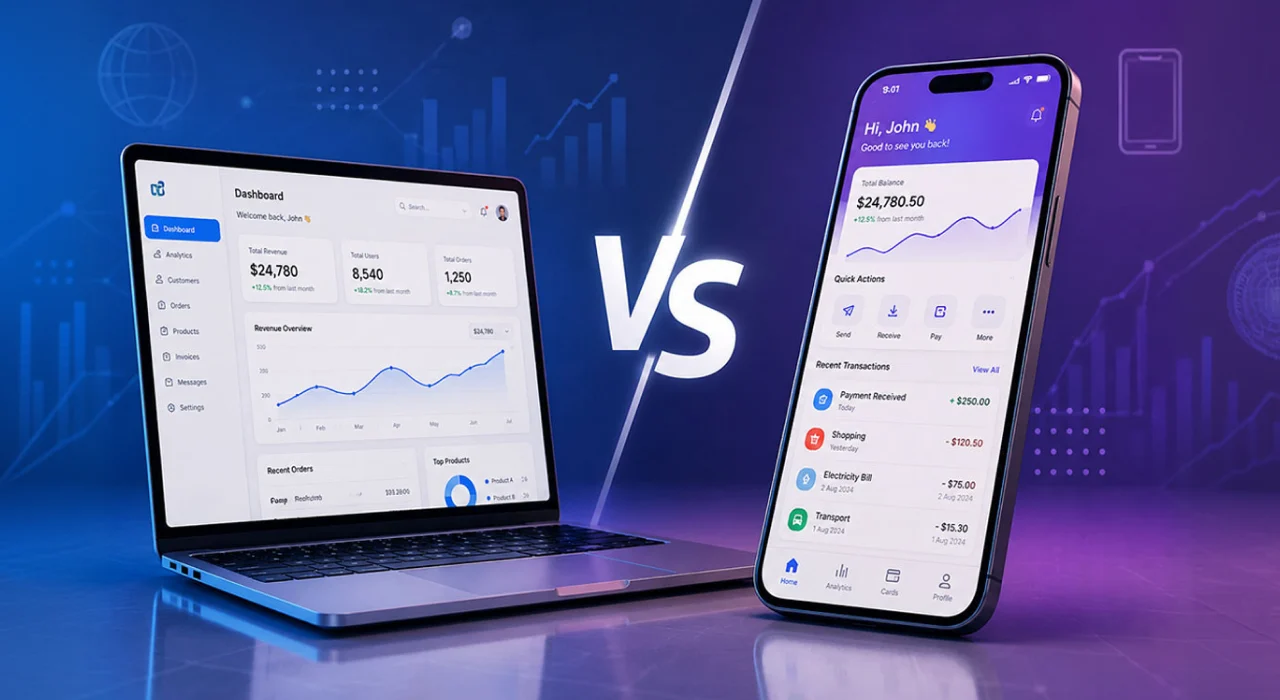
Table of contents
- Quick Answer: Should You Build a Web App or Mobile App?
- Why This Decision Matters More Than Ever
- Understanding the Difference Between Web Apps and Mobile Apps
- Web App vs Mobile App: Which Is Better for Your Business?
- Web App vs Mobile App: Comparison
- Progressive Web Apps (PWAs): The Middle Ground
Businesses today have more options than ever to build digital products, acquire customers, and drive revenue. Yet one question continues to challenge startup founders, product owners, and enterprise decision-makers:
Should you invest in web app development or mobile app development?
The answer can significantly impact your budget, customer acquisition strategy, user engagement, and long-term return on investment (ROI).
Many businesses make the mistake of choosing a mobile app because mobile usage is growing. Others launch only a web application and later struggle with customer retention and engagement.
The reality is that there is no universal winner.
The right investment depends on your business model, customer behavior, growth stage, and revenue goals.
In this guide, we'll compare web app development and mobile app development based on cost, performance, scalability, SEO visibility, user engagement, ROI, and current technology trends to help you make the right investment decision in 2026.
Quick Answer: Should You Build a Web App or Mobile App?
For most startups and businesses launching a new digital product, a web application is usually the smartest first investment because it offers:
- Faster development
- Lower costs
- Better SEO visibility
- Easier maintenance
- Wider audience reach
A mobile application becomes a stronger investment when:
- Users interact with your platform daily
- Push notifications drive engagement
- Customer retention is critical
- Offline access is important
- Device-specific features are required
Expert Insight
For most businesses, the most cost-effective strategy is:
Launch a web application first, validate market demand, and then expand into mobile app development once user adoption is proven.
This approach reduces risk, accelerates time to market, and maximizes ROI.

Why This Decision Matters More Than Ever
Consumer behavior continues to evolve rapidly.
According to Statista, mobile devices generated more than 52.27% of global website traffic in 2026, highlighting the dominance of smartphones in digital interactions.
At the same time, users spend the majority of their mobile time inside apps rather than browsers.
This creates a critical business challenge:
Customers often discover businesses through websites, but they frequently become loyal users through mobile apps.
This is why companies like Amazon, Airbnb, Spotify, Uber, and Shopify invest heavily in both web and mobile experiences.
Understanding the Difference Between Web Apps and Mobile Apps
What Is a Web App?
A web application is software program that runs through a browser and can be accessed through a URL without installation.
Examples include:
- Google Docs
- Trello
- Canva
- HubSpot
- Shopify
Web applications are commonly built using technologies such as:
- React
- Angular
- Vue.js
- Next.js
- Node.js
Key Advantage
Users can access a web app instantly without downloading anything.
What Is a Mobile App?
A mobile application is software specifically developed for smartphones and tablets.
Users download mobile apps from:
- Apple App Store
- Google Play Store
Mobile applications can be developed as:
- Native iOS Apps
- Native Android Apps
- Cross-Platform Apps using Flutter or React Native
Examples include:
- Uber
- Spotify
- Duolingo
Key Advantage
Mobile apps can leverage device hardware such as GPS, cameras, biometrics, sensors, and push notifications.
Web App vs Mobile App: Which Is Better for Your Business?
1. Development Cost
One of the biggest factors influencing investment decisions is cost.
Web App Development Cost
Estimated range:
| Project Type | Typical Cost |
|---|---|
| Basic Web App | $10,000 - $25,000 |
| Custom Web App | $25,000 - $50,000+ |
| Enterprise Web Application | $50,000 - $100,000+ |
Estimated range:
| Project Type | Typical Cost |
|---|---|
| Basic Mobile App | $15,000 - $30,000 |
| Custom Mobile App | $30,000 - $80,000+ |
| Enterprise Mobile App | $80,000 - $150,000+ |
Winner: Web App
A single codebase typically makes web applications more affordable to build and maintain.
2. Time to Market
Speed can determine whether your product gains early traction or loses momentum.
Web Applications
Average timeline: 2-6 months
Mobile Applications
Average timeline: 3-12 months
Additional time is often required for:
- App Store approval
- Platform testing
- Device compatibility
Winner: Web App
If rapid launch and market validation are priorities, web applications usually provide a faster path.
3. SEO and Customer Acquisition
This is one of the biggest advantages of web app development.
A web application can rank for thousands of relevant search terms and attract visitors through:
- Google Search
- AI Overviews
- ChatGPT recommendations
- Gemini responses
- Perplexity citations
For example, a SaaS platform can rank for:
- CRM software
- Project management tools
- Accounting software for startups
Mobile apps do not offer the same SEO visibility.
Winner: Web App
If lead generation and organic traffic matter, web applications have a significant advantage.
4. User Engagement and Retention
This is where mobile apps excel.
Mobile applications provide:
- Push notifications
- Personalized experiences
- Faster interactions
- Home-screen presence
Research consistently shows that apps generate stronger engagement and retention than websites because users interact with them more frequently.
Winner: Mobile App
5. Performance
Native mobile applications are optimized for specific operating systems.
Benefits include:
- Faster execution
- Better animations
- Improved responsiveness
- Superior offline performance
Modern web technologies have narrowed the gap significantly, but native mobile apps still provide the best performance.
Winner: Mobile App
6. Offline Functionality
Mobile applications can operate even without internet access.
This is especially valuable for:
- Travel apps
- Healthcare apps
- Productivity tools
- Field-service applications
While Progressive Web Apps (PWAs) support offline capabilities, native mobile apps still offer the strongest offline experiences.
Winner: Mobile App
7. Maintenance and Updates
Web applications are easier to update because changes happen centrally.
Users automatically access the latest version.
Mobile applications require:
- Store submissions
- User updates
- Version management
Winner: Web App

Web App vs Mobile App: Comparison
| Criteria | Web App | Mobile App |
|---|---|---|
| Development Cost | Lower | Higher |
| Time to Market | Faster | Slower |
| SEO Visibility | Excellent | Limited |
| User Engagement | Moderate | High |
| Push Notifications | Available | Excellent |
| Offline Access | Limited | Excellent |
| Performance | Good | Excellent |
| Customer Retention | Moderate | High |
| Maintenance | Easier | More Complex |
| Device Features | Limited | Full Access |
| Reach | Wider | Download Required |
Progressive Web Apps (PWAs): The Middle Ground
One of the fastest-growing trends in modern application development is the adoption of Progressive Web Apps.
PWAs combine the strengths of websites and mobile apps.
Features include:
- Offline access
- Push notifications
- Fast loading speeds
- Home-screen installation
- Cross-platform compatibility
Major brands including Starbucks and Pinterest have successfully adopted PWAs to improve accessibility and performance.
Can a PWA Replace a Mobile App?
In many cases, yes.
A PWA is often an excellent choice for:
- Startups
- MVP development
- eCommerce businesses
- Content platforms
- Service marketplaces
However, applications requiring advanced hardware integrations may still benefit from native mobile development.
Which Delivers Better ROI?
This is ultimately the question that matters most.
Web App ROI Is Usually Higher When:
- You need market validation
- SEO drives customer acquisition
- Budget is limited
- You serve B2B customers
- Lead generation is a priority
Examples:
- SaaS Platforms
- CRM Systems
- Internal Business Tools
- Customer Portals
Mobile App ROI Is Usually Higher When:
- Customers engage daily
- Retention impacts revenue
- Subscription models exist
- Push notifications drive conversions
Examples:
- FinTech Apps
- Fitness Apps
- Food Delivery Apps
- Ride-Sharing Platforms
Industry-Specific Recommendations
SaaS Businesses
Recommendation: Web App First
Why?
SaaS products rely heavily on SEO, content marketing, and browser-based workflows.
eCommerce Businesses
Recommendation: Web App + Mobile App
Customers often discover products through search engines but make repeat purchases through apps.
Healthcare Platforms
Recommendation: Mobile App First
Appointment reminders, telemedicine, and health tracking benefit from mobile accessibility.
FinTech Companies
Recommendation: Mobile App First
Mobile apps provide stronger security, authentication, and user engagement.
Marketplaces
Recommendation: Web App First, Mobile App Second
This approach balances acquisition and retention effectively.
Latest App Development Trends in 2026
AI-Powered Applications
AI is transforming both web and mobile experiences.
Businesses are integrating:
- AI chatbots
- Intelligent search
- Predictive analytics
- Recommendation engines
- Workflow automation
You may also like: AI in Mobile App Development: A Definitive Guide
Cross-Platform Development
Frameworks such as Flutter and React Native continue to reduce development costs while maintaining strong performance.
Cloud-Native Architecture
Scalable cloud infrastructure has become essential for modern applications.
Cybersecurity and Privacy
Users increasingly expect:
- Multi-factor authentication
- Biometric login
- Secure payment processing
- Transparent data practices
Web App or Mobile App: What Should You Build First?
Choose a Web App First if:
- You need SEO visibility
- You want faster market validation
- Budget is limited
- You are launching an MVP
- Lead generation is important
Choose a Mobile App First if:
- Daily engagement drives revenue
- Retention is critical
- Offline access is required
- Device features are essential
- Push notifications increase conversions
Choose Both if:
- You have proven demand
- You are scaling rapidly
- Customer experience is a competitive advantage
Final Verdict
The best choice is not determined by technology. It is determined by business objectives.
If your priority is organic growth, customer acquisition, lower costs, and faster deployment, invest in web app development.
If your priority is engagement, retention, personalization, and customer loyalty, invest in mobile app development.
For most businesses in 2026, the smartest strategy is to start with a web application, validate demand, and expand into mobile app development as the business grows.
Frequently Asked Questions
1. Is a web app affordable than a mobile app?
Yes. Web applications generally require lower development and maintenance costs because they use a single codebase.
2. Which is better for startups?
For most startups, a web application is the preferred first investment because it enables faster validation and lower costs.
3. Can a web app become a mobile app later?
Yes. Many businesses launch a web application first and later develop mobile apps based on customer demand.
4. Are Progressive Web Apps replacing mobile apps?
Not entirely. PWAs are growing rapidly, but native apps remain important for advanced functionality and superior user experiences.
5. How long does app development take?
Most web applications take 2-6 months, while mobile applications typically require 3-12 months depending on complexity.
6. Which is better for SEO?
Web applications are significantly better for SEO because they can rank in search engines and attract organic traffic.
7. Do I need both a web app and mobile app?
Many successful businesses eventually invest in both because each serves different stages of the customer journey.

Jignesh Nakrani is the Co-Founder and Operations Director at XongoLab Technologies LLP. He channels his interests into researching cutting-edge technology and the latest trends in business to create content related to the web and mobile to help startups & entrepreneurs scale their businesses and grow.
View All Post
You May also Like
Mobile App Development
How Much Does Mobile App Development Cost? Find Out Here
- Ankit Patel
- |
- May 25, 2026

OTT App Development
A Detailed Guide to Netflix-like OTT App Development [+Cost]
- Jignesh Nakrani
- |
- May 25, 2026
OTT App Development
OTT App Development Cost - Features, Process & Trends
- Ankit Patel
- |
- May 25, 2026